What Is Enterprise Reputational Risk? Meaning, Causes, Examples and How to Manage It
A company’s reputation takes years to build and can be damaged in a single day. One data breach, one viral complaint or one public mistake by a senior leader can change how customers, employees, investors and regulators see an organization.
For large organizations, this is not a small public relations problem. When stakeholders lose trust, the damage can reach sales, hiring, partnerships, investment and even the company’s licence to operate.
This guide explains what enterprise reputational risk is, what causes it, the main types, how it differs from brand risk and digital risk, and how organizations can manage it.
What Is Enterprise Reputational Risk?
Enterprise reputational risk is the possibility that an event, decision or action damages how stakeholders view an organization, and that this loss of trust leads to financial, operational or strategic harm.
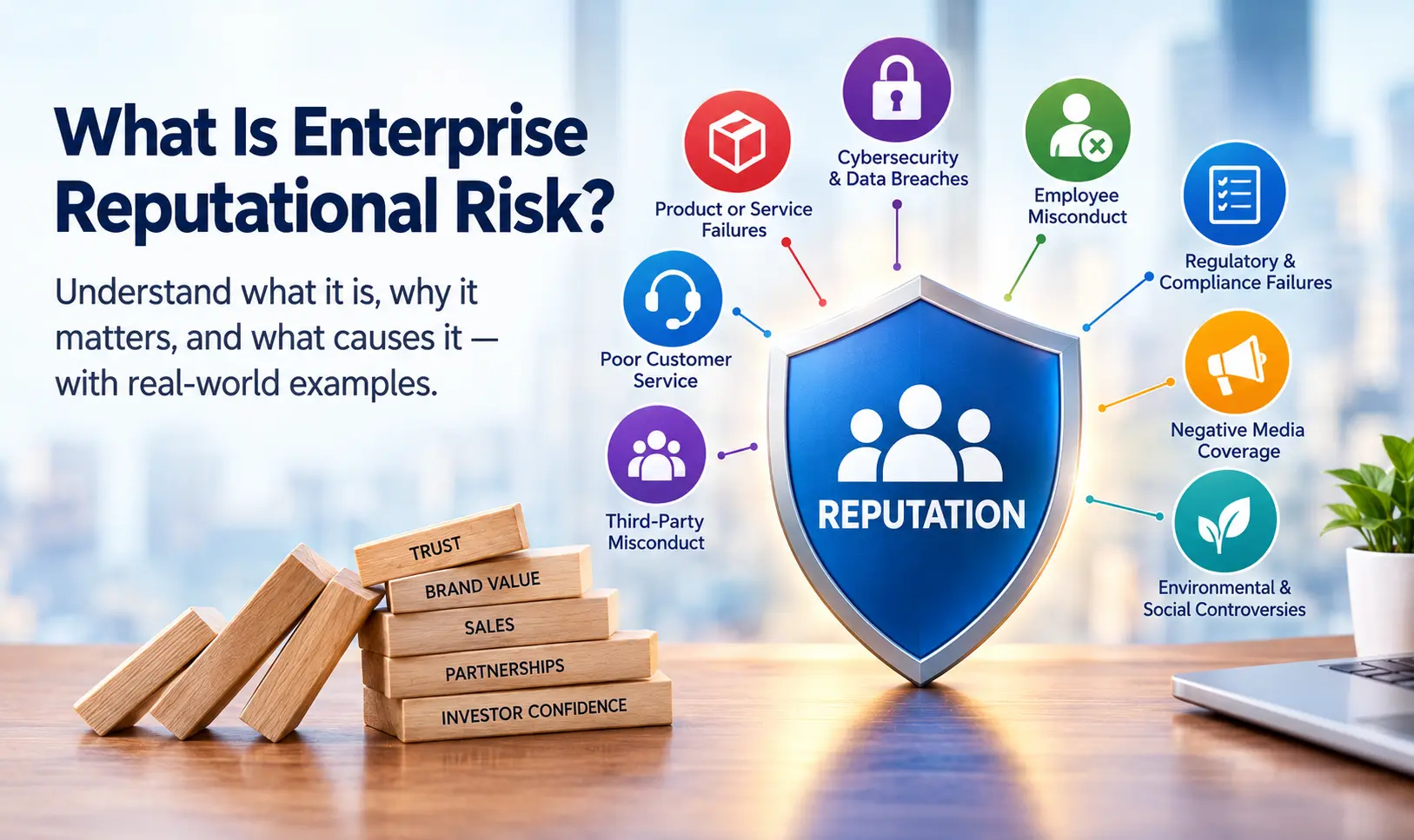
It can come from many sources, including:
- Data breaches and cybersecurity incidents
- Poor customer service
- Product failures or recalls
- Employee or executive misconduct
- Ethical or compliance violations
- Negative media coverage
- Misleading advertising or public statements
- Environmental or social controversies
- Misconduct by suppliers or partners
- A poor response to a crisis
An important point: reputational risk does not only come from what a company does on purpose. An employee, a supplier, a technology failure or a cyberattack can damage a company’s reputation even when leadership did nothing wrong.
Take a customer data breach as an example. The breach itself is a cybersecurity risk. It becomes a reputational risk when customers believe their data was handled carelessly, or when the company communicates badly after the incident.
Why Enterprise Reputational Risk Matters
Reputation is one of a company’s most valuable assets. It shapes how customers, employees, investors, regulators and suppliers decide whether to trust the organization.
A strong reputation supports customer loyalty and growth. A damaged reputation can lead to:
- Loss of customers and sales
- Higher customer acquisition costs
- Difficulty hiring and keeping good employees
- Loss of business partnerships
- Closer attention from regulators
- Concern among investors and lenders
- Higher crisis management costs
- Long-term damage to brand value
Reputational damage also acts as a multiplier. A cybersecurity incident may start as a technical problem, but if customers stop trusting the company to protect their information, it quickly becomes a commercial problem as well.
This is why enterprise reputational risk should not be left to the marketing or PR team alone. It affects the whole organization and needs attention from senior leadership.
What Causes Enterprise Reputational Risk?
Reputational risk can start in almost any part of an organization. These are the most common causes.
Cybersecurity and Data Breaches
Customers expect companies to protect their personal and financial information. When that information is exposed, trust can fall very quickly.
The reputational impact usually depends on:
- What type of data was exposed
- How many people were affected
- Whether reasonable security controls were in place
- How quickly the incident was detected
- How openly the company communicated
- What the company did to protect the people affected
Not every security incident destroys a reputation. Poor preparation and unclear communication are often what turn a manageable incident into a lasting crisis. A planned data breach response helps organizations communicate clearly and protect trust when an incident happens.
Product and Service Failures
Customers judge a company first by what it delivers. Faulty products, repeated service outages, claims that cannot be proven and unhelpful customer support all create a negative impression.
A single problem can usually be fixed. The real damage happens when the same failures repeat and the company does not respond properly. Customer confidence then declines slowly and is hard to win back.
Employee and Leadership Misconduct
The behaviour of employees and executives can create serious reputational concerns, especially when the company appears to tolerate it.
Examples include fraud, harassment, discrimination, conflicts of interest and abuse of authority.
Leadership behaviour matters most. Senior executives are often seen as a reflection of the company’s culture and values, so their actions can affect how people view the entire organization.
Regulatory and Compliance Failures
Breaking laws, regulations, contract terms or industry standards can cause serious reputational harm. Even when a fine is small, negative attention can last long after the legal matter is closed.
Companies that operate in several countries, or in heavily regulated industries such as financial services and healthcare, face extra complexity because rules and expectations differ from market to market. In the UAE, for example, organizations must also consider local requirements such as the Personal Data Protection Law when handling customer information.
Third-Party and Supply Chain Problems
A company’s reputation can suffer because of the businesses it works with. Suppliers, contractors, distributors and technology providers can all create risk if they act unethically, illegally or carelessly.
This is why third-party risk management is closely linked to enterprise reputational risk.
Main Types of Enterprise Reputational Risk
Reputational risk can be grouped into a few broad categories:
- Operational risk: service outages, delivery failures or quality problems that damage stakeholder confidence.
- Cyber and digital risk: data breaches, privacy failures or misuse of digital platforms. Because online news spreads fast, these incidents can grow very quickly.
- Compliance and ethical risk: situations where a company is believed to have broken laws, regulations, ethical standards or its own stated values.
- Leadership risk: poor decisions, inappropriate public statements, conflicts of interest or misconduct by executives.
- Third-party risk: negative publicity caused by suppliers, partners or contractors.
For a detailed breakdown with examples, read our guide to the types of reputational risks businesses face.
Reputational Risk vs Brand Risk
Reputational risk and brand risk are closely related, but they are not the same.
Brand risk is about potential damage to how people see a company’s brand and the value of that brand.
Reputational risk is broader. It covers how all stakeholders, including customers, employees, investors, regulators and partners, view the organization as a whole.
For example, a controversial advertising campaign may mainly create brand risk. A major data breach, on the other hand, can damage trust among customers, employees, investors, regulators and business partners at the same time.
In practice, the two often overlap.
Reputational Risk vs Digital Risk
Digital risk is the exposure a company faces because it depends on technology, data, online platforms and digital operations.
Reputational risk is often one of the results of digital risk. A typical chain looks like this:
Cyberattack → data leak → customer concern → negative media coverage → loss of trust in the company
This is why organizations should never treat technology risks in isolation. Every digital risk should also be assessed for its possible business and reputational impact.
How to Manage Enterprise Reputational Risk
Reputational risk can never be removed completely. However, organizations can identify their biggest exposures, reduce avoidable risks, spot problems early and prepare for incidents.
1. Identify Reputation-Critical Risks
Start by finding the activities that could seriously affect stakeholder trust. These may include cybersecurity, customer experience, product quality, employee behaviour, regulatory compliance, leadership conduct, supply chains and public communications.
The goal is not to list everything that could go wrong. It is to understand which events could cause the most damage.
2. Understand Stakeholder Expectations
Different stakeholders care about different things. Customers may focus on quality and privacy. Employees may care most about workplace culture. Investors may focus on governance and financial stability, while regulators focus on compliance.
Knowing these expectations helps organizations decide which risks matter most.
3. Monitor Early Warning Signs
Organizations should track signals that may show a change in how they are perceived, such as:
- Customer complaints and online reviews
- Social media discussions
- News coverage
- Employee feedback
- Regulatory announcements
- Industry trends
- Security incidents
Monitoring should not only count negative mentions. Sudden changes in sentiment or unusual patterns are often the earliest warning signs. Ongoing reputation intelligence monitoring helps leadership teams spot these signals before they become a crisis.
4. Prepare a Crisis Response Plan
When a serious incident happens, the company must respond quickly and consistently. A crisis response plan should set out:
- Who makes key decisions
- Who speaks to stakeholders
- How incidents are escalated
- How facts are checked
- How customers and employees are informed
- How corrective actions are communicated
Preparation matters, because decisions made in the first hours of a crisis can affect a company’s reputation for years.
5. Coordinate Communication
During a major incident, different departments must not share conflicting information. The response may involve security, legal, compliance, communications, customer service and executive teams.
Clear and accurate communication is essential, because unclear messages lead to speculation.
6. Manage Third-Party Risk
Organizations should assess the reputational risk linked to their key suppliers and partners. This includes due diligence, clear contract requirements, compliance monitoring and agreed escalation steps.
For a full step-by-step framework, read our reputation risk management guide for enterprises.
Example: A Website Outage at a Large Online Retailer
Imagine a large online retailer whose website goes down during the busiest shopping season of the year.
At first, this looks like a technology problem. But the risks quickly grow:
Website goes down → customers cannot place orders → complaints increase → negative posts and news spread → customers lose confidence → sales and goodwill fall
The reputational risk is not only the outage itself. It is the loss of trust caused by how the company handles it.
If the retailer communicates honestly, shares regular updates, finds the cause quickly and takes steps to stop it happening again, it can greatly reduce the long-term damage.
How Is Enterprise Reputational Risk Measured?
Reputation is built from the views of many different stakeholder groups, so it is hard to reduce to a single number.
Instead, organizations can track a mix of indicators, such as:
- Customer satisfaction and retention
- Customer complaint volumes
- Employee turnover and feedback
- Media coverage
- Online sentiment and reviews
- Brand perception surveys
- Regulatory issues
- Security incidents
- Problems with partners or suppliers
A combination of these signals is more useful than a single reputation score. Trends matter most: a slow rise in complaints or negative sentiment is often an early warning sign of a bigger problem.
Common Mistakes in Managing Reputational Risk
Treating reputation as a PR task only. Reputation is shaped by decisions across the whole company, not only by the marketing or communications team.
Focusing only on major crises. Small problems that repeat, such as unresolved complaints or ignored employee concerns, can slowly damage trust.
Speaking before checking the facts. Rushed, inaccurate or inconsistent statements can make a situation worse.
Assuming the risk ends when the incident ends. Stakeholders often continue to judge a company by how it handled the problem, long after it is fixed.
Frequently Asked Questions
What is enterprise reputational risk?
Enterprise reputational risk is the possibility that an organization’s actions, decisions, incidents, employees, partners or products damage stakeholder trust and cause financial, operational or strategic harm.
Why is reputational risk important for enterprises?
Trust matters to customers, employees, investors, regulators and suppliers. When that trust is lost, the company can face lower sales, hiring difficulties, regulatory attention and investor concern.
What are common examples of reputational risk?
Common examples include data breaches, product failures, poor customer service, employee misconduct, regulatory violations, negative media coverage, leadership failures and problems with suppliers or partners.
Is brand risk the same as reputational risk?
No. Brand risk focuses on how people see a company’s brand. Reputational risk is broader and covers how all stakeholders view the organization as a whole.
Can reputational risk be completely prevented?
No. However, organizations can reduce it through strong governance, good cybersecurity, compliance management, third-party risk checks, monitoring, crisis preparation and clear communication.
Who is responsible for managing reputational risk?
It is a shared responsibility. Senior leadership sets the direction, while teams such as risk management, compliance, cybersecurity, communications, human resources, legal and operations each manage the risks in their own area.
Conclusion
Enterprise reputational risk is the chance that an event, decision, behaviour or failure causes stakeholders to lose trust in an organization.
It can come from cybersecurity incidents, operational problems, employee behaviour, leadership decisions, compliance failures, product issues or third parties. Because reputation is affected by every part of a business, managing it takes much more than good public relations.
Organizations that understand their key risks, know what stakeholders expect, watch for early warning signs, manage third parties carefully and prepare for crises are far better placed to protect their reputation.
The core lesson is simple: reputation is built through consistent decisions over time, but it can be lost quickly when one incident is handled badly.
Want to know where your organization is most exposed? Request a reputation risk assessment from the BigBuzz team.

 Home
Pingback: Types of Reputational Risks Businesses Face