Home
Home 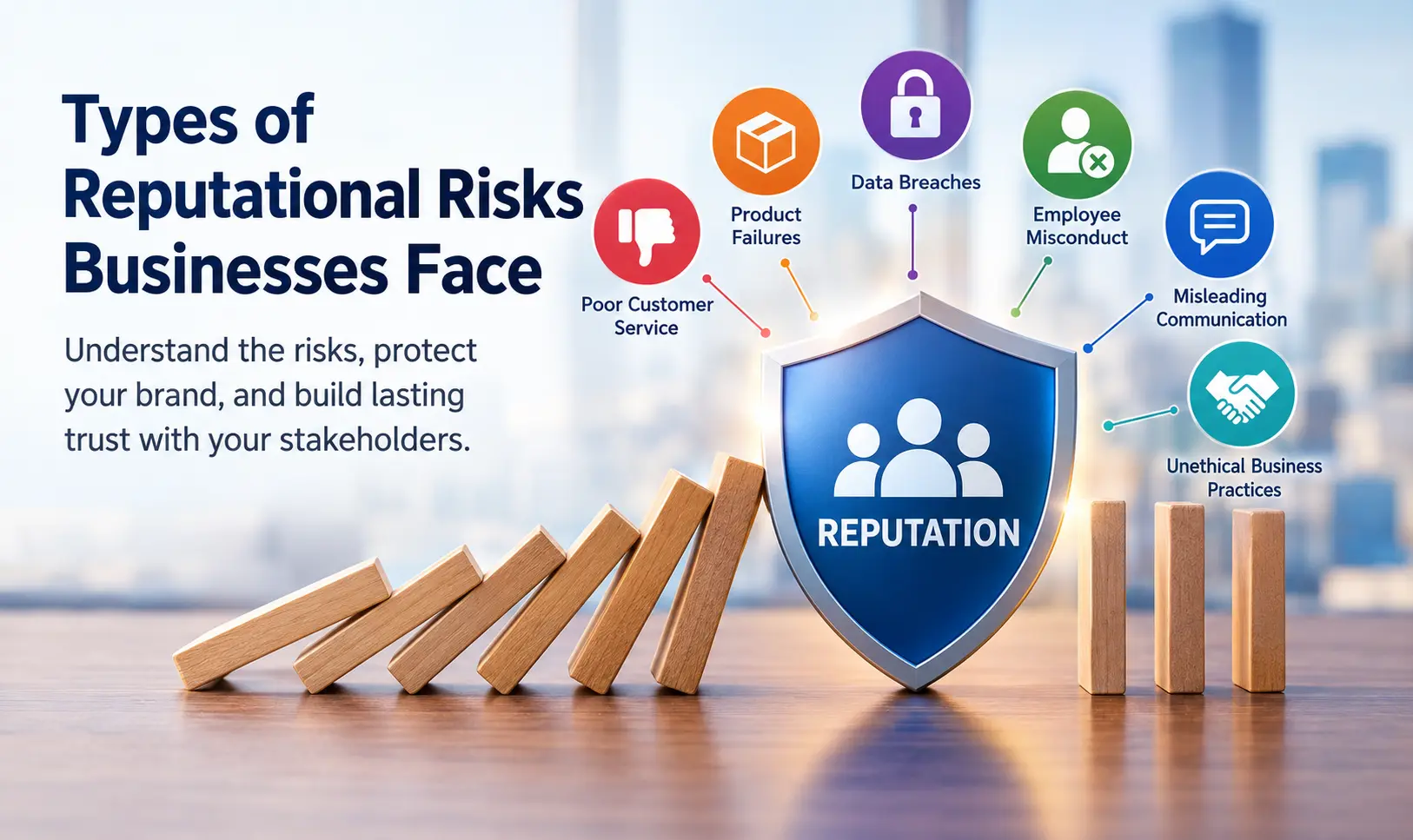
A enterprise’s popularity can be damaged through many precise events, from terrible customer support and product disasters to records breaches, worker misconduct, deceptive communique, or unethical enterprise practices. These problems can reduce client accept as true with, have an impact on worker morale, entice horrible publicity, and create financial or operational problems.
Understanding the types of reputational dangers groups face helps organizations come to be aware about vulnerabilities early and expand suitable responses.
What is reputational chance?
Reputational chance is the possibility that an event, motion, choice, or commercial enterprise exercise will damage how clients, personnel, customers, partners, regulators, or the public perceive an organization.
Reputational chance does now not generally come from some thing the organization deliberately does. A third birthday celebration, employee, supplier, cyberattack, or surprising event can also create reputational damage.
For example, an company may additionally have strong security controls but still suffer reputational damage if a company exposes consumer records. Similarly, one employee’s public behavior can create terrible attention for the complete corporation.
Consequently, recognition is prompted by way of what a business organisation does and the way stakeholders apprehend its actions.
Why Reputational Risk Matters
A broken popularity can have an effect on many more than public opinion.
Customers can also forestall searching for from the commercial enterprise. Employees might also end up less inclined to stay or suggest the company as a workplace. Business companions may reconsider their relationships, whilst buyers and lenders may additionally become greater careful.
Reputational harm can also make other risks more intense. A cybersecurity incident, for example, may begin with a era trouble, however a awful communication afterward can turn it into a miles larger trouble.
The results include:
- Loss of clients and income
- Negative media coverage
- Declining client don’t forget
- Difficulty attracting and retaining employees
- Increased regulatory attention
- Loss of company partnerships
- Reduced investor self belief
- Higher crisis-manage prices
- Long-time period damage to brand price
Not every reputational incident produces all of those outcomes, but intense incidents can affect numerous areas right now.
Major Types of Reputational Risks Businesses Face
Reputational risks can originate from many components of an agency. Some are induced internally, even as others come from external activities or third parties.
1. Product or Service Quality Risk
Poor services and products are a few of the maximum direct resources for reputational harm.
Customers rely on a industrial business enterprise to deliver what it ensures. Defective products, unreliable services, faulty records, repeated service disasters, or horrible client research can rapid reason proceedings and terrible critiques.
For example, a software program company releases updates that motive clients to lose get right of entry to to important capabilities. Even if the business enterprise eventually fixes the hassle, customers also can start wondering whether or not they can rely on the product.
Product remembers, protection troubles, and big provider screw ups can create even extra reputational outcomes.
The threat turns into specifically intense while an business enterprise:
- Ignores patron court cases
- Fails to well known a diagnosed trouble
- Provides deceptive product data
- Delays corrective action
- Responds poorly to affected customers
2. Customer Service and Customer Experience Risk
An enterprise may also have an wonderful product; but, it can nevertheless expand a poor recognition due to how it treats customers.
Long reaction times, unhelpful guide, unresolved court cases, uncertain policies, or disrespectful interactions can lead clients to proportion poor memories publicly.
Social media and overview systems make character client tales more seen than they once had been.
For example, one unresolved complaint can attain many humans if a customer posts approximately the revel in publicly, and the submit gets massive attention.
This does not advocate that every terrible evaluation creates a critical reputational disaster. The more problem is a sample of negative patron research combined with an inadequate reaction from the organisation.
3. Cybersecurity and Data Privacy Risk
Cybersecurity incidents can fast come to be reputational sports.
A statistics breach, ransomware incident, unauthorized get entry to, or exposure of sensitive consumer facts may also cause stakeholders to question whether or not or not a organization can shield their records.
The reputational impact frequently depends on greater than the breach itself. How the enterprise responds to topics.
For example, customers may react negatively if a employer:
- Takes too lengthy to reveal a crucial incident
- Provides uncertain facts
- Appears to reduce the problem
- Fails to guide affected clients
- Repeats similar protection disasters
Organizations that address personal, financial, healthcare, or other sensitive records may additionally face in particular suitable-sized accept as true with consequences while safety controls fail.
[Internal Link: What Is Enterprise Digital Risk?]
four. Employee Misconduct Risk
Employees can create reputational threats via misconduct, especially whilst their moves are related publicly to the corporation.
Examples encompass harassment, discrimination, fraud, conflicts of hobby, and different public conduct, abuse of authority, or violations of business enterprise tips.
The risk can increase while leadership seems to tolerate or forget about misconduct.
For example, if an worker in a senior role is accused of huge misconduct and the organization fails to analyze successfully, stakeholders can also additionally question the business enterprise’s tradition and leadership— now not clearly the man or woman’s behavior.
Strong inner policies, reporting mechanisms, investigations, and obligation techniques can help lessen this hazard.
5. Leadership and Executive Reputation Risk
Senior executives regularly represent the agency publicly, because of this that their movements can at once affect the corporate popularity.
Poor management selections, unethical behavior, misleading statements, conflicts of interest, and inappropriate public feedback can entice giant attention.
The hazard is in particular high when an executive’s private reputation is intently associated with the organisation ‘s logo.
A management controversy can therefore have an effect on the following:
- Customer be given as true with
- Employee confidence
- Investor sentiment
- Media coverage
- Business relationships
Companies have to recognize that authorities reputation and employer popularity can end up carefully associated.
6. Ethical and Corporate Governance Risk
Businesses can suffer reputational damage, even if stakeholders agree that they will be appearing unethically or failing to maintain appropriate governance requirements.
Examples include:
- Conflicts of interest
- Bribery or corruption
- Fraud
- Misleading reporting
- Weak oversight
- Poor selection-making
- Failure to comply with inner controls
- Concealment of crucial information
Even even though an issue does now not immediately bring about monetary losses, the belief that a company lacks integrity may be difficult to opposite.
Good corporation governance permits groups to establish responsibility and make alternatives that align with legal, moral, and stakeholder expectancies.
7. Regulatory and Compliance Risk
Failure to comply with applicable legal guidelines, policies, standards, or contractual requirements can lead to reputational problems.
A regulatory violation can also bring about effects, investigations, public proceedings, or prolonged scrutiny.
However, reputational outcomes can growth beyond formal consequences.
Stakeholders may also moreover ask why the company failed to comply inside the first area and whether or not comparable problems exist some other place in the business enterprise.
This is especially important in regulated industries, together with economic services, healthcare, pharmaceuticals, telecommunications, and electricity.
[Internal Link: Enterprise Risk Management Explained]
eight. Social Media and Online Reputation Risk
Social media can growth reputational incidents extraordinarily speedy.
A complaint, controversial statement, employee incident, product hassle, or client video can spread a ways past the particular audience.
Online recognition chance can rise up from every respectable company bills and content material fabric published with the aid of manner of employees, clients, influencers, or exclusive 0.33 activities.
Corporations can’t absolutely manipulate how human beings discuss their producers on-line.
Businesses can reduce publicity by way of tracking applicable conversations, keeping clean conversation guidelines, responding efficaciously to legitimate issues, and having a crisis verbal exchange method.
The reason should now not be to get rid of every terrible comment. Instead, businesses need to awareness on identifying important troubles and responding constructively.
nine. Supply Chain and Third-Party Risk
An employer ‘s popularity may be stricken by the movements of carriers, contractors, vendors, era companies, and different organisation partners.
For instance, a provider accused of unethical work practices might also create awful interest for an business enterprise that purchases from it.
Similarly, a 3rd-birthday party service company experiencing a protection incident ought to have an effect on the popularity of the enterprise that is predicated on its services.
This is why reputational chance management should expand beyond the company’s private employees and operations.
[Internal Link: Third-Party Risk Management Guide]
10. Environmental and Sustainability Risk
Environmental practices can impact stakeholders’ perceptions of business enterprises.
Concerns also can contain pollutants, waste management, aid use, environmental harm and deceptive sustainability claims.
An enterprise might also face reputational damage if it publicly claims to be environmentally responsible at the same time as its actual practices appear inconsistent with the ones claims.
This is frequently related to greenwashing, wherein environmental advantages or sustainability credentials are provided in a deceptive or exaggerated way.
Businesses should ensure that sustainability communications are supported with correct evidence and mirror their real practices.
eleven. Workplace Culture and Employee Treatment Risk
How an organisation treats its personnel might also have a big impact on its popularity.
Issues along with discrimination, harassment, risky running situations, unfair remedy, immoderate workloads, and terrible place of work lifestyle can become public through worker opinions, social media, news insurance, or prison court docket cases.
Employee recognition is specially vital because present day and former employees can offer direct money owed of organizational practices.
A employer that continuously invests in truthful treatment, place of work protection, conversation, and employee well-being is usually higher positioned to maintain stakeholder perception.
12. Financial Misconduct and Financial Reputation Risk
Financial issues can also create reputational threat, mainly while stakeholders trust that the enterprise acted dishonestly or irresponsibly.
Examples can consist of:
- Financial fraud
- Misleading economic disclosures
- Accounting misconduct
- Misuse of corporation budget
- Conflicts of interest
- Poor monetary controls
Not every monetary hassle results in reputational failure. Businesses can enjoy legitimate monetary issues with out incorrect moves.
The reputational risk becomes more giant whilst stakeholders don’t forget that the agency hid information, misled them, or didn’t act responsibly.
thirteen. Crisis Communication Risk
Sometimes a unique incident is doable; but, the business enterprise ‘s response makes the reputational harm worse.
Poor crisis conversation can contain untimely responses, contradictory statements, loss of transparency, blaming customers, beside-the-point messaging, or failing to cope with legitimate issues.
For example, an organisation handling a product hassle may additionally moreover have already got a hard state of affairs. If it responds by way of using disregarding consumer problems in preference to explaining what took place and what it’s miles doing to restore the trouble, public grievance may additionally additionally develop.
Effective disaster conversation ought to be timely, actual, clear, and appropriate to the scenario.
14. Marketing and Advertising Risk
Marketing campaigns can create reputational problems if they’re deceptive, insensitive, offensive, or inconsistent with the agency ‘s values.
Risk can rise up from exaggerated claims, beside the factor messaging, misleading advertising and marketing and marketing, negative cultural focus, or advertising that creates unrealistic expectations.
Even a industrial that changed into no longer meant to motive harm can generate significant complaints if audiences interpret it in another way from the commercial enterprise company’s meant message.
Careful evaluation and trying out of touchy campaigns can assist in figuring out capacity troubles earlier than booklet.
Internal vs. External Reputational Risks
Reputational risks are regularly less tough to apprehend whilst divided into two big training.
Internal reputational risks originate in the business organization. Examples encompass worker misconduct, terrible leadership, unethical practices, weak governance, terrible customer support, and workplace tradition problems.
External reputational dangers originate outdoor the company’s direct manage. Examples include cyberattacks, terrible media coverage, dealer screw ups, activist campaigns, market activities, and movements through 1/3 occasions.
The distinction is useful; but, the lessons often overlap.
For example, a cyberattack may be external; but, prone internal safety practices have to develop its effect. Similarly, horrific media insurance may additionally moreover originate externally, whilst being induced via an internal industrial agency preference.
How Businesses Can Manage Reputational Risk
Managing recognition isn’t always really approximately preventing negative publicity. It involves identifying the underlying risks that might inspire stakeholders to lose their notion.
Sensible strategies encompass:
Identify popularity-touchy sports
Determine which merchandise, services, personnel, suppliers, methods, and enterprise choices should create big stakeholder issues.
Understand stakeholder expectations
Different stakeholders can also care approximately distinctive troubles. Customers may additionally be interested by high-quality and privacy, personnel in place of business culture, consumers in governance and transparency, and regulators in compliance.
Monitor capacity warning signs
Businesses can monitor patron court cases, worker comments, media insurance, social media discussions, regulatory trends, and operational incidents.
The cause is to discover rising troubles earlier than they end up principal crises.
Establish clear reaction methods
Organizations must understand who’s answerable for responding to considerable incidents and how data need to be communicated internally and externally.
Address troubles in preference to actually coping with appearances
Reputation manipulate is more effective when groups correct the underlying difficulty in place of that specialize in public perception.
An organisation cannot sustainably protect its reputation if the practices causing stakeholder concerns continue to be unchanged.
Examples of Reputational Risk
Consider a few simple eventualities.
A facts breach: A retailer reviews a cybersecurity incident that exposes patron records. The technical incident creates a cybersecurity hazard, whilst terrible communication in a while creates an additional reputational danger.
A supplier controversy: A apparel agency discovers crucial exertions concerns involving a issuer. Although the enterprise did no longer right away hire the people, stakeholders may additionally although query its supply-chain practices.
Poor customer support: A telecommunications enterprise organization receives a large style of lawsuits approximately billing problems however does no longer treatment them fast. Customers begin sharing their memories publicly, detrimental to the brand.
Executive misconduct: A senior authorities reputable turns into worried in unethical conduct. If the employer appears to disregard the hassle, stakeholders may also view the issue as proof of broader governance weaknesses.
These examples screen an important thing: reputational hazard is regularly the final results of any other commercial agency ’schance becoming seen to stakeholders.
What Makes Reputational Risk Difficult to Manage?
Reputational threats are tough because popularity is primarily based in part on notion.
Two corporations can enjoy similar operational problems; however, one among a type reputational outcomes depend upon how stakeholders interpret the event and how the companies respond.
Reputational harm also can spread all through fantastic risk categories. A single occasion may additionally concurrently incorporate cybersecurity, criminal, operational, financial, compliance, and reputational dangers.
Another assignment is that reputation can take years to construct; however, it can be broken speedy through a excessive incident.
Therefore, reputational danger must now not be handled as the handiest public member of the family trouble. It should be taken into consideration as part of broader agency danger control.
[Internal Link: What Is Enterprise Reputational Risk?]
Frequently Asked Questions
What are the predominant sorts of reputational threats?
Common sorts embody product and provider disasters, customer service problems, cybersecurity incidents, worker misconduct, control problems, moral and governance screw ups, regulatory violations, social media issues, transport-chain troubles, environmental worries, place of work lifestyle problems, and negative disaster conversation.
What is an example of a reputational risk?
A file breach that exposes purchaser statistics is a commonplace example. The protection incident can damage client agree with, at the same time as horrific conversation or an insufficient reaction can growth the reputational impact.
Is reputational chance an internal or external chance?
It can be both. Internal risks can come from employees, management, governance, merchandise, or commercial company practices, even as outdoor dangers can involve cyberattacks, suppliers, media coverage, or different 0.33 parties.
Why are reputational threats essential for businesses?
A damaged reputation can lessen patron believe, affect worker retention, make partnerships extra difficult, attract regulatory interest, and create monetary consequences.
How can a agency reduce its reputational danger?
Businesses can reduce reputational dangers by using identifying vulnerabilities, preserving strong governance and compliance methods, protecting client facts, tracking growing problems, coping with 1/3 parties, helping employees, and getting ready clean disaster-reaction techniques.
Can reputational damage be completely removed?
No. Businesses cannot manipulate each event or public perception. The sensible intention is to end up aware about giant dangers, reduce preventable troubles, and respond speedy and responsibly whilst incidents rise up.