Home
Home 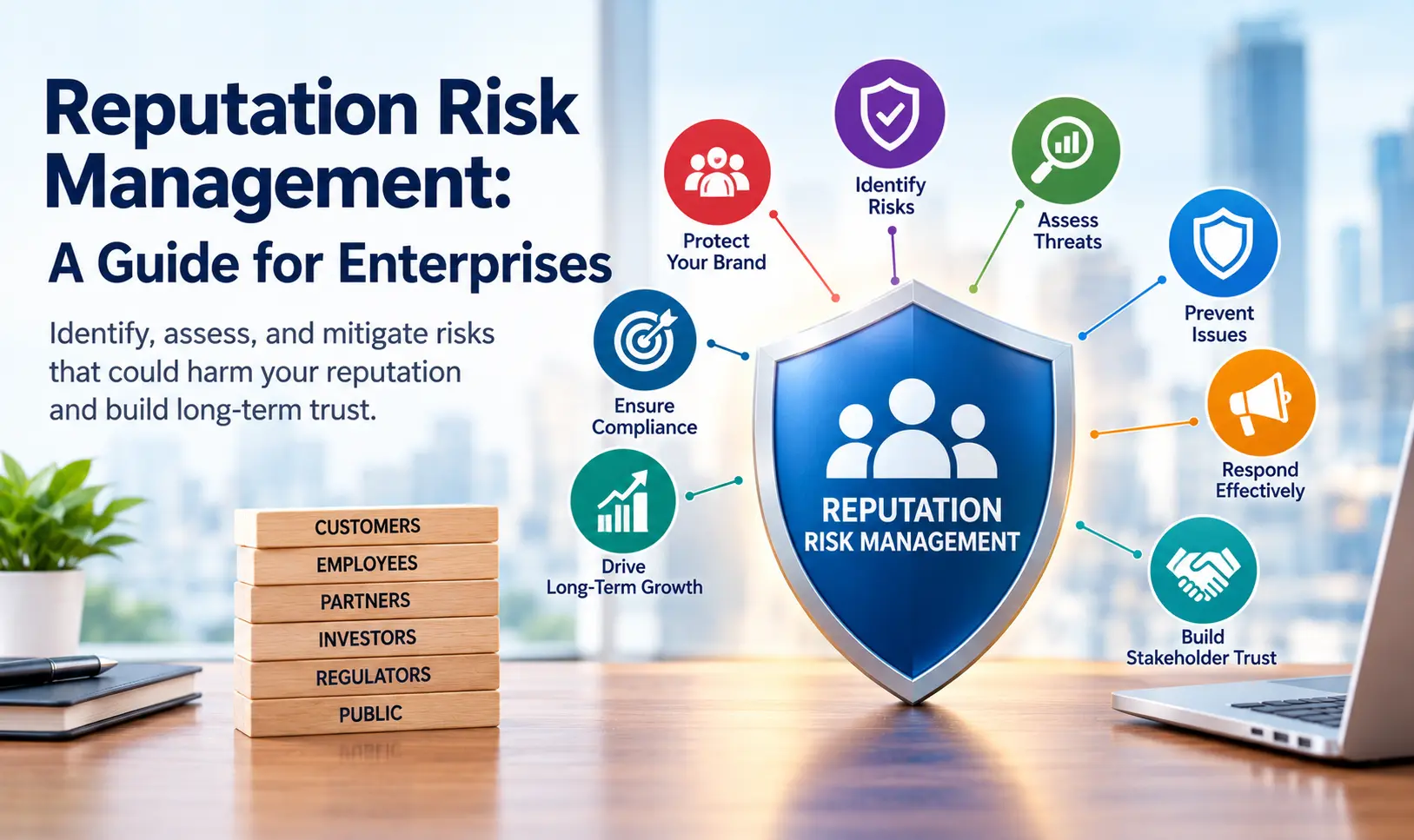
Reputation Risk Management: A Guide for Enterprises
Reputation risk management is the process of identifying, assessing, and reducing threats that could damage how customers, employees, investors, regulators, and the public perceive an organization. For enterprises, effective reputation risk management involves monitoring potential threats, preparing for crises, maintaining ethical business practices, and responding quickly when trust is at risk.
A strong reputation can support customer loyalty, business partnerships, employee retention, and long-term growth. However, negative publicity, data breaches, poor customer experiences, leadership misconduct, or failures in corporate governance can undermine that trust. Enterprises need a structured approach to identify these risks before they escalate and manage them when they occur.
What Is Reputation Risk Management?
Reputation risk management is a systematic approach to protecting an organization’s credibility, public image, and stakeholder trust. It helps businesses understand what could damage their reputation, evaluate the potential consequences, and establish processes to prevent or respond to reputational incidents.
Unlike risks that are limited to financial losses or operational disruptions, reputation risk can affect several areas of a business simultaneously. For example, a cybersecurity incident may expose customer information, attract negative media coverage, raise regulatory concerns, and reduce customer confidence.
Reputation risk management is therefore not just the responsibility of the public relations or marketing team. It requires coordination among executive leadership, risk management, legal, compliance, cybersecurity, human resources, customer service, and other relevant departments.
The goal is not to eliminate every possibility of negative publicity. Instead, enterprises should reduce avoidable risks, detect emerging problems, respond responsibly, and preserve stakeholder confidence over time.
Why Is Reputation Risk Management Important for Enterprises?
Large organizations often operate across multiple markets, industries, supply chains, and regulatory environments. This complexity creates more opportunities for an incident in one area to affect the entire business.
Protects Customer Trust
Customers expect businesses to deliver reliable products, protect personal information, and handle complaints fairly. When an organization fails to meet these expectations, customers may switch to competitors or share negative experiences publicly.
A structured reputation risk management process helps businesses identify recurring customer concerns and address the underlying causes before they become larger problems.
Reduces Financial and Commercial Consequences
Reputational damage can contribute to lost sales, higher customer acquisition costs, delayed partnerships, and difficulties attracting investment. The financial impact depends on the nature of the incident, the organization’s response, and the expectations of its stakeholders.
Identifying reputational threats early can help enterprises limit the scale and duration of these consequences.
Supports Regulatory and Compliance Objectives
Organizations that fail to meet legal requirements, industry standards, or ethical expectations may face regulatory scrutiny and public criticism.
Reputation risk management works alongside compliance and enterprise risk management to help businesses identify situations where misconduct, inadequate controls, or poor governance could damage stakeholder confidence.
Strengthens Employee Confidence
Employees are also important stakeholders. Concerns about workplace culture, discrimination, unethical leadership, or poor management practices can damage an employer’s reputation.
Addressing these concerns helps organizations create a more accountable workplace and can support recruitment, retention, and employee engagement.
Improves Crisis Preparedness
Reputational incidents can develop quickly, particularly when information spreads through social media and online news platforms.
A crisis response plan establishes responsibilities, communication procedures, approval processes, and escalation criteria before an incident occurs. This preparation helps decision-makers respond more consistently under pressure.
Common Reputation Risks Enterprises Need to Manage
Reputation risks differ by industry, business model, and stakeholder expectations. However, several categories affect organizations across sectors.
1. Cybersecurity and Data Privacy Risks
Cyberattacks, unauthorized access, data leaks, and mishandling of personal information can undermine confidence in an organization.
For example, a company that exposes customer records may face complaints, negative media coverage, legal obligations, and questions about whether its security controls are adequate.
Enterprises can reduce these risks through security monitoring, access controls, employee training, incident response planning, and responsible handling of customer information.
2. Leadership and Corporate Governance Risks
The conduct of executives and board members can have a significant influence on public trust.
Conflicts of interest, financial misconduct, misleading statements, unethical decisions, or a failure to address internal concerns may create serious reputational consequences.
Clear governance policies, independent oversight, ethical leadership, and effective reporting channels can help organizations identify and address these problems.
3. Customer Experience Risks
Poor service, unreliable products, misleading advertising, billing disputes, and unresolved complaints can damage customer relationships.
A single complaint may have a limited effect, but repeated failures can indicate a systemic problem. If customers consistently report the same issue, enterprises should investigate the operational cause rather than focusing only on individual responses.
Customer feedback analysis, service quality monitoring, and transparent complaint resolution can help reduce these risks.
4. Employee and Workplace Culture Risks
Workplace harassment, discrimination, unsafe working conditions, unfair treatment, and retaliation against employees who raise concerns can damage an organization’s reputation.
These issues may become public through employee complaints, investigations, news reports, or online discussions.
Enterprises should establish clear workplace standards, provide confidential reporting channels where appropriate, investigate allegations fairly, and take corrective action when problems are substantiated.
5. Legal, Regulatory, and Compliance Risks
Violations of applicable laws, industry requirements, contractual obligations, or internal policies can damage stakeholder confidence.
Examples include misleading disclosures, inadequate compliance controls, improper business practices, or failure to meet relevant privacy requirements.
Effective compliance monitoring, internal audits, employee education, and timely remediation help organizations reduce the likelihood of these incidents.
6. Supply Chain and Third-Party Risks
An enterprise’s reputation can be affected by the behavior of suppliers, contractors, distributors, and other business partners.
For example, a supplier accused of using exploitative labor practices may create reputational concerns for the company purchasing its products, particularly when the relationship conflicts with the company’s public commitments.
Organizations should evaluate third-party risks, conduct proportionate due diligence, monitor critical suppliers, and establish clear expectations for ethical conduct.
7. Environmental and Social Responsibility Risks
Stakeholders may scrutinize an organization’s environmental impact, labor practices, community relationships, and sustainability claims.
Problems can arise when business activities conflict with public commitments or when marketing statements exaggerate environmental or social achievements.
Enterprises should support public claims with reliable evidence, communicate limitations honestly, and integrate relevant environmental and social considerations into business decisions.
8. Digital and Social Media Risks
Online conversations can amplify customer complaints, misinformation, employee concerns, and criticism of business decisions.
Not every negative comment represents a major reputational threat. However, sudden increases in relevant complaints, credible allegations, or recurring customer concerns may indicate an issue that requires investigation.
Businesses should monitor relevant online discussions, verify information before responding, and avoid reacting defensively to criticism.
How Does Reputation Risk Management Work?
An effective reputation risk management framework connects risk identification, assessment, prevention, response, and continuous improvement.
Step 1: Identify Potential Reputation Risks
Begin by identifying the events, decisions, and business activities that could damage stakeholder trust.
Useful information sources include:
- Customer complaints and feedback.
- Employee surveys and internal reporting channels.
- Cybersecurity and operational incident reports.
- Compliance reviews and internal audits.
- Supplier assessments.
- Media coverage and relevant online discussions.
- Investor questions and stakeholder feedback.
The objective is to identify both existing problems and emerging threats. Enterprises should also examine previous incidents to understand where controls or communication processes failed.
Step 2: Assess the Likelihood and Impact of Each Risk
Not every reputational threat deserves the same level of attention. Businesses need to evaluate how likely an incident is to occur and how serious its consequences could be.
Assessment criteria may include:
- The number and importance of stakeholders affected.
- Potential financial and operational consequences.
- Legal or regulatory implications.
- The credibility and visibility of the issue.
- The speed at which the problem could escalate.
- The organization’s ability to detect and respond to it.
For example, a recurring complaint about a minor service issue may require operational improvement, while evidence of a widespread customer data exposure may require immediate executive escalation.
A reputation risk register can help record identified risks, their owners, existing controls, ratings, and mitigation plans.
Step 3: Establish Preventive Controls
Once the most significant risks are identified, enterprises should implement controls that address their underlying causes.
Depending on the risk, these controls may include:
- Strong cybersecurity and privacy practices.
- Clear codes of conduct and ethics policies.
- Employee training and confidential reporting mechanisms.
- Third-party due diligence.
- Quality assurance and customer complaint procedures.
- Compliance monitoring and internal audits.
- Accurate public disclosures and responsible marketing.
Controls should be proportionate to the organization’s size, industry, exposure, and risk appetite.
Step 4: Monitor Reputation Signals
Continuous monitoring helps organizations recognize changes in stakeholder sentiment and identify potential problems earlier.
Enterprises may monitor customer feedback, complaint volumes, media coverage, employee concerns, relevant social media conversations, and emerging industry issues.
Monitoring should focus on meaningful signals rather than simply counting mentions or measuring whether comments are positive or negative. A sudden increase in complaints about a specific product, for example, may reveal a quality issue that requires investigation.
Organizations should establish thresholds for escalation so that credible, high-impact concerns reach the appropriate decision-makers promptly.
Step 5: Prepare a Reputation Crisis Response Plan
Even well-managed organizations can experience incidents that affect public trust. A crisis response plan helps ensure that the organization can act quickly and responsibly.
The plan should identify:
- Who has authority to declare and manage a crisis.
- Which teams must be involved.
- How facts will be verified.
- Who can approve public statements.
- How customers, employees, regulators, and other stakeholders will be informed.
- How the organization will document decisions and corrective actions.
Enterprises should test their plans through exercises based on realistic scenarios, such as a data breach, product recall, executive misconduct allegation, or major service outage.
Step 6: Respond Transparently and Correct the Problem
When an incident occurs, organizations should establish the facts, protect affected stakeholders, and take appropriate action.
A useful response generally includes acknowledging the issue when warranted, communicating verified information, explaining what is being done, and providing updates as the situation develops.
Businesses should avoid making unsupported assurances or speculating about the cause before an investigation establishes the facts.
Communication alone cannot repair a serious underlying failure. If the problem resulted from defective products, weak security, or misconduct, meaningful corrective action is essential.
Step 7: Review the Outcome and Improve Controls
After the immediate incident has been addressed, conduct a review to determine what happened, how the response performed, and which improvements are necessary.
The review should examine the effectiveness of detection systems, escalation procedures, decision-making, stakeholder communication, and corrective measures.
Lessons learned should be incorporated into risk assessments, policies, training, and crisis plans. This turns reputation risk management into an ongoing business process rather than an activity that occurs only after a crisis.
Building a Reputation Risk Management Framework
Enterprises need a framework that defines accountability and integrates reputational considerations into existing risk management processes.
Executive and Board Oversight
Senior leaders and the board should understand the organization’s most significant reputation risks and how they relate to strategic objectives.
They do not need to manage every complaint or media inquiry. Their role is to provide oversight, approve appropriate risk tolerances, allocate resources, and ensure that serious issues receive sufficient attention.
Clear Ownership and Accountability
Reputation risk management often crosses departmental boundaries. Without clear responsibilities, teams may assume that another department is handling an emerging problem.
Organizations should assign risk owners and define how concerns move between operational teams, risk management, legal, compliance, communications, and executive leadership.
Integration With Enterprise Risk Management
Reputation risk should not be treated as an isolated category. It frequently arises as a consequence of other business risks, including operational failures, cyber incidents, financial misconduct, compliance breaches, and third-party problems.
Integrating reputation risk into enterprise risk management helps organizations evaluate the broader consequences of business decisions and prioritize resources consistently.
Defined Policies and Escalation Procedures
Documented policies help employees understand acceptable conduct, reporting expectations, and the process for escalating potential reputational threats.
Escalation criteria should reflect the seriousness of the incident, the credibility of available information, and the potential consequences for stakeholders.
Regular Testing and Improvement
Frameworks should be reviewed as the organization changes. New technologies, acquisitions, market expansion, changes in customer expectations, and emerging threats may create risks that existing controls do not adequately address.
Periodic reviews and crisis simulations help enterprises identify weaknesses before they become more difficult to manage.
How to Measure Reputation Risk Management Effectiveness
Reputation risk is difficult to measure with a single metric because stakeholder trust is influenced by many factors. Enterprises should use a combination of leading indicators, incident measures, and outcome measures.
Useful indicators include:
- Customer complaint trends: Whether complaints are increasing, recurring, or being resolved effectively.
- Customer trust and satisfaction: Changes in survey results, retention, or relevant customer feedback.
- Employee confidence: Trends in engagement surveys, workplace concerns, and employee turnover.
- Incident frequency and severity: The number and seriousness of events that create reputational exposure.
- Response time: How quickly credible concerns are identified, escalated, and addressed.
- Corrective action completion: Whether identified control weaknesses are resolved within agreed timeframes.
- Stakeholder sentiment: Changes in relevant media coverage, public discussion, and stakeholder feedback.
These indicators should be interpreted in context. For example, an increase in reported incidents may reflect better reporting rather than worsening performance. Similarly, positive online sentiment does not necessarily mean an organization has strong controls or ethical practices.
The most useful measurement approach links indicators to clear risk thresholds, assigned owners, and specific management actions.
Common Reputation Risk Management Mistakes
Treating Reputation as a Public Relations Problem
Communications teams can help explain an incident, but they cannot independently resolve problems caused by defective products, misconduct, or weak internal controls.
Effective management requires both clear communication and operational correction.
Ignoring Early Warning Signs
Repeated customer complaints, employee concerns, audit findings, or supplier issues may reveal weaknesses before they become public.
Organizations should investigate credible patterns instead of dismissing them as isolated problems.
Responding Before Verifying the Facts
An inaccurate statement can make an already difficult situation worse. Enterprises should establish what is known, identify uncertainties, and communicate responsibly without unnecessary delays.
Overpromising or Making Unsupported Claims
Promises that cannot be fulfilled may create additional distrust. Public statements about security, sustainability, customer protection, or ethical conduct should reflect actual practices and available evidence.
Failing to Learn From Incidents
Closing an incident without addressing its root cause leaves the organization vulnerable to similar problems. Every significant event should inform improvements to controls, training, and response procedures.
Reputation Risk Management Example
Consider an enterprise that discovers a security weakness in a customer-facing platform.
Initially, the issue may appear to be a technical problem. However, if customer information is affected, the consequences could extend to privacy concerns, customer complaints, regulatory scrutiny, and negative media coverage.
An effective response would involve several coordinated actions.
First, the cybersecurity team investigates the weakness and takes appropriate steps to contain the threat. The legal and compliance teams assess applicable obligations, while executive leadership receives updates on the incident’s severity and potential business impact.
The communications team prepares accurate, coordinated messages for affected stakeholders. Customer support receives guidance for responding to inquiries, and the organization provides required notifications where applicable.
After containment, the enterprise investigates the root cause, implements corrective measures, and reviews whether existing monitoring and escalation procedures were adequate.
This example illustrates an important principle: reputation risk management works best when organizations address the underlying incident and its effects on stakeholders together.
Frequently Asked Questions
What is the main goal of reputation risk management?
The main goal is to protect stakeholder trust by identifying potential reputational threats, reducing their likelihood or impact, and preparing the organization to respond responsibly when incidents occur.
What is the difference between reputation risk management and reputation management?
Reputation risk management focuses on identifying, assessing, preventing, and responding to threats that could damage an organization’s reputation. Reputation management is broader and may also include activities intended to build a positive public image, strengthen brand perception, and maintain stakeholder relationships.
Who is responsible for reputation risk management in an enterprise?
Responsibility is shared across the organization. The board and executive leadership provide oversight, risk management coordinates the framework, and departments such as cybersecurity, legal, compliance, human resources, operations, and communications manage the risks relevant to their responsibilities.
What tools can enterprises use to manage reputation risk?
Organizations may use risk registers, social listening platforms, media monitoring tools, customer feedback systems, employee reporting channels, incident management software, and enterprise risk management platforms. The appropriate tools depend on the organization’s size, risk exposure, and monitoring requirements.
How often should enterprises review reputation risks?
Reputation risks should be monitored continuously where practical, with formal assessments conducted at intervals appropriate to the organization’s risk profile. Significant incidents, acquisitions, regulatory changes, new products, and major operational changes should also trigger a review.
Can reputation risk be eliminated completely?
No. Enterprises cannot control every external event, stakeholder reaction, or public discussion. They can, however, reduce avoidable risks, strengthen internal controls, improve transparency, and respond more effectively when problems arise.
Conclusion
Reputation risk management is an essential part of responsible enterprise governance. It helps organizations identify threats to stakeholder trust, strengthen preventive controls, prepare for crises, and respond effectively when incidents occur.
The most effective approach connects reputation risk with cybersecurity, compliance, operations, workplace culture, third-party oversight, and enterprise risk management. It also recognizes that protecting a reputation requires more than controlling public messages: businesses must address the underlying issues that influence how stakeholders perceive them.
Enterprises should start by identifying their most significant reputational threats, assigning clear ownership, establishing measurable indicators, and testing their response plans. With consistent monitoring and a commitment to accountability, organizations can become better prepared to manage reputational challenges and maintain trust over the long term.