Home
Home 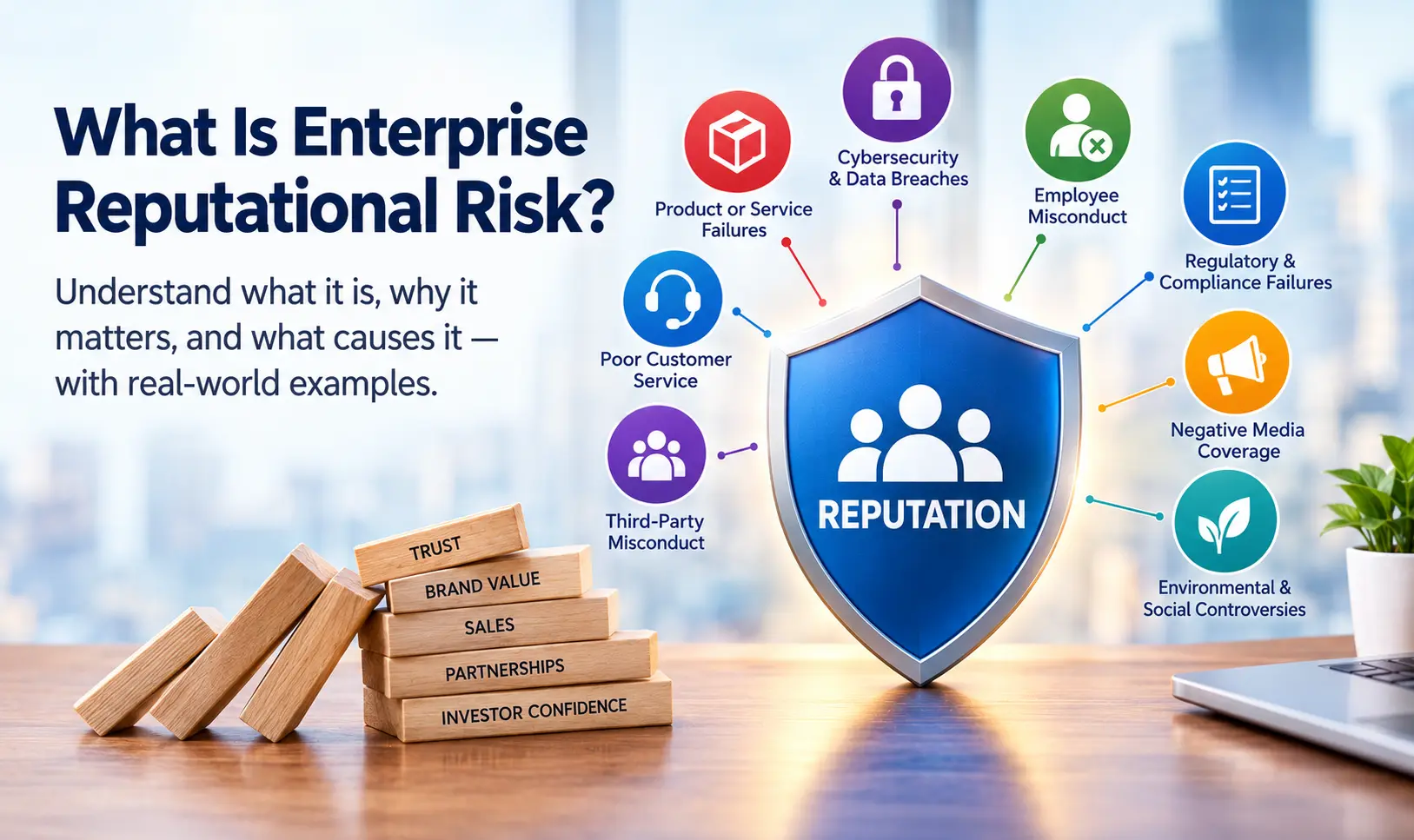
What Is Enterprise Reputational Risk?
Enterprise reputational risk refers back to the danger of reputational damage to an enterprise due to its actions, decisions, incidents or movements via employees, companions merchandise or stakeholders.
This can impair patron believe, sales, worker retention, partnerships, investor self-assurance and even the very ability of the business enterprise to operate in a meaningful manner.
The recognition of massive corporations is a excessive stakes difficulty as one blunders can set the excellent of social media, news structures, evaluation web sites and on-line communities on fireplace. An organization lacking the important thing isn’t handiest a small operational trouble but additionally might also emerge as a business issue when clients or stakeholders lose trust inside the organization.
What Is Enterprise Reputational Risk?
Enterprise reputational risk, defined as the potential for financial, operational or strategic harm from terrible perception of an employer.
It comes from lots of conditions, which include:
- Data breaches and cybersecurity incidents
- Poor customer service
- Product screw ups or recollects
- Employee misconduct
- Ethical or compliance violations
- Negative media coverage
- Misleading advertising or public statements
- Environmental or social controversies
- Third-birthday party or provider misconduct
- Leadership screw ups
- Poor responses to a disaster
The key aspect is that no longer all of reputational risk arises from what a agency does on purpose. An employee, provider, era failure, cyberattack or other outside event can harm an employer and not using a direct fault mendacity in the organization.
Let us take some other instance a enterprise going through customer statistics breach. A cybersecurity danger is simply created through the technical incident itself, but the reputational hazard arises most effective if the organization would not respond nicely. Trust may additionally decline if customers believe their non-public records changed into mishandled or that the agency did a terrible process of communicating after the breach.
Enterprise Reputational Risk: Why is it Important?
Reputation is a main employer asset because it affects how purchasers, employees, investors, regulators and suppliers and other stakeholders view an enterprise.
A solid reputation enables create client loyalty and enterprise improvement. Sometimes, a broken recognition ought to do the alternative.
The outcomes might also consist of:
- Loss of clients
- Reduced sales
- Increased purchaser acquisition fees
- Difficulty attracting employees
- Higher worker turnover
- Loss of commercial enterprise partnerships
- Increased regulatory attention
- Investor concerns
- Higher prices throughout disaster control
- Long-term harm to emblem consider
However, reputational damage can act as a multiplier to some dangers.
Consider that a cybersecurity incident can also begin as a technology difficulty. This also offers a reputational and business issue if clients begin to lose faith inside the enterprise defensive sensitive information.
That is the motive why company reputational hazard ought to no longer be visible handiest as a advertising and marketing or public members of the family problem. That will be throughout numerous sections of the company.
What Causes Enterprise Reputational Risk?
Reputational threat can stand up from almost any area of an employer.
Cybersecurity and Data Breaches
Cyberattack incidents mark one of the maximum conspicuous kinds of reputational hazard.
Sensitive statistics is predicted by clients to be protected with the aid of companies. If compromising purchaser, worker, economic or enterprise information occurs a breach can act fast to erode consider.
The reputational results may additionally vary via:
- What records became exposed
- How many humans were affected
- If the organization had proper safety controls
in vicinity
- The velocity at which the incident turned into
detected
- How transparently the enterprise communicated
- Stakeholders have been covered with the aid of
motion taken
Not each protection incident will break a company’s reputation. Bad education, coupled with horrific communique can exacerbate the harm dramatically!
Product or Service Failures
Products and services impact how clients view your organization immediately.
A awful enjoy with defective products, continual down time of offerings, an incapability to substantiate product claims and a terrible customer service can create bad perceptions.
One problem will be clean. As we hold to fail and don’t hear the right response, the client’s confidence dies out slowly.
Employee and Leadership Misconduct
Particularly, whilst the organization is seen to tolerate beside the point conduct, worker and government conduct can increase reputational worries.
Which could involve fraud, harassment or abuse, discrimination, conflicts of hobby, unethical interest or different examples of great misconduct.
The importance of the leadership behavior is especially applicable because senior executives are regularly seen to encompass key elements of the cultures in their corporations (Wright et al 2009).
Regulatory and Compliance Failures
Any breach of laws, regulations, contractual obligations or standards inside the enterprise can lead to disastrous reputational results.
And even if the monetary quality is achievable, damaging interest can continue to exist long past a regulated problem being positioned to rest.
Additionally, agencies with a worldwide reach or in closely regulated industries can also come upon complexity from one market to all other considering expectations and requirements can vary.
Third-Party and Supply Chain Problems
The popularity of an business enterprise may suffer because of other organizations that it does enterprise with.
Partners together with providers, contractors, vendors, and era providers may additionally introduce recognition chance with the aid of collaborating in unethical, illegal, risky or irresponsible activities.
That is the purpose why 1/3 celebration chance management hits very near home with organization reputational threat.
Types of Enterprise Reputational Risk
Reputational risk may be split into a few broad classes.
Operational Reputational Risk
It occurs when stakeholder self-belief is broken by using operational screw ups.
You understand, like service outages that final too lengthy, deliveries that by no means make it, merchandise that don?
Cyber and Digital Reputational Risk
This may want to include cybersecurity incidents, privacy breaches, compromised structures or their inappropriate use on digital platforms resulting in reputation damage.
Due to the excessive-velocity nature of digital news, reputation-affecting activities in cyberspace can increase speedy.
Compliance and Ethical Reputational Risk
Such a state of affairs occurs while an agency is suspected of breaching legal guidelines, regulations, ethical requirements or their very own values.
Leadership Reputational Risk
Executives, senior leaders have the strength to persuade how stakeholders view a whole company.
Enterprise-wide reputational effect will turn up from terrible selections, irrelevant public statements or other such conflicts of hobby or misconduct.
Third-Party Reputational Risk
This is when providers, partners, contractors or different external companies generate negative publicity for the corporation.
Enterprise Reputational Risk vs Brand chance
Enterprise reputational danger and emblem threat are closely associated, but they are no longer synonymous.
Brand Risk Brand threat specifically refers to ability harm induced to the belief and value of a employer’s brand.
Reputational chance is broader. It is set all the perceptions that one-of-a-kind stakeholders have approximately an corporation.
Take a debatable advertising and marketing campaign—risking brand risk is probably your simplest output. A cyber incident or breach is of enough significance to endanger the wider popularity of customers, employees, investors, regulators and commercial enterprise partners.
In fact these areas overlap in exercise.
Enterprise Reputation Risk vs Digital Risks
Another associated concept is virtual threat.
Digital hazard comprises the exposure that an employer faces due to its reliance on digital technology, structures, information, platforms and on-line operations.
One viable final results of virtual threat is organisation reputational chance.
For example:
**A breach is essentially: cyberattack → data leak → customer or consumer worry and concern → awful media headlines/lack of credibility/agree with in the emblem/company.**
It is leader among those that businesses have to never consider era risks in a vacuum from its capacity commercial enterprise and reputational implications.
How does Enterprise Reputational Risk work?
Such risk can not be completely eliminated. Instead, businesses ought to discover, mitigate foremost resources of exposure avoidable dangers, pre-empt emerging issues and put together for incidents.
1.
Identify Reputation-Critical Risks
First, step become aware of activities that could have unfolding consequences for stakeholder trust.
That could encompass everything from cybersecurity and customer experience to product great, worker behavior, regulatory compliance, leadership style, supply chains and public communications.
There no longer meant to be all the matters that might move incorrect. To gain perception into what activities might also do the maximum harm to the popularity of an company.
2.
Understand Stakeholder Expectations
Expectations among various stakeholders may also vary.
Customers are willing to sacrifice privateness and the best of a product. Workplace Culture may additionally be counted to personnel Investors may favor governance and monetary balance. Regulators can also focus on compliance.
Knowing these expectations allows enterprises to discover the pinnacle dangers.
3.
Monitor Emerging Issues
Organizations also can scan relevant resources for signals of any ability recognition exchange.
These might also encompass:
- Customer comments
- Social media discussions
- News insurance
- Online evaluations
- Employee feedback
- Regulatory announcements
- Industry tendencies
- Security incidents
Monitoring must no longer be restrained to simply terrible mentions. Changes in sentiment or unusual behavior can also yield useful early caution signals.
4.
Prepare a Crisis Response Plan
If a critical incident takes area, the organization ought to respond quick and continuously.
Crisis Response Plan ought to outline:
- Who makes key decisions
- Who communicates with stakeholders
- How incidents are escalated
- How facts are validated
- How customers and personnel are informed
- How corrective moves are communicated
And, coaching is mainly important as choices in a disaster can bring about reputational harm for years yet to come.
5.
Coordinate Communications
During a prime incident exclusive departments have to no longer talk contradictory facts.
The reaction can also contain the enforcement of safety, felony, compliance, communications, customer service and government teams
It is vital to speak surely and appropriately, as ambiguity often breeds speculation.
6.
Manage Third-Party Risk
Organizations ought to assess the reputational risk tied to key providers and partners.
Third-0.33-celebration reputational risk mitigation lies in undertaking due diligence, continuity contractual necessities, compliance tracking and express escalation approaches.
Enterprise Reputational Risk Example
Imagine a massive on line store’s internet site is going down in the course of the holiday purchasing season.
The easy trouble can be a method or generation failure.
However, numerous dangers can broaden:
**System Down→Orders can not be carried out by means of the clients→Increased Complaints→Negative coverage spreads round the clock→Customers lose self belief,Cash Highway down and It loses its goodwill**
Therefore, the reputational hazard isn’t always just about that outage. This translates into the potential loss of trust inside the very agency which you are serving and implementing strategy for as a reaction to this incident.
Provided the business enterprise does all of this — actually speaking, imparting updates regularly, identifying quickly what induced the problem and taking steps to prevent it from taking place once more — it may mitigate the reputational harm long time.
How Is Enterprise Reputational Risk Measured?
Reputation, a composite of perceptions from a couple of stakeholder groups, is tough to distill down to a single range.
Organizations can screen each qualitative and quantitative indicators which includes:
- Customer satisfaction
- Customer proceedings
- Customer retention
- Employee turnover
- Employee remarks
- Media coverage
- Online sentiment
- Brand perception
- Regulatory problems
- Security incidents
- Partner issues
A unmarried reputation rating is sort of never as beneficial as a aggregate of those signals.
Another element organizations need to note is the tendencies. Even before an outage, a slow rising trend in client proceedings or terrible sentiment can function an early caution sign.
6 Mistakes in Managing Reputational Risk
A not unusual false impression is to recall recognition totally as a task of the advertising and marketing or public relations team.
You are impacted via corporation-extensive decisions affecting reputation.
Another failure is giving attention to simplest huge disasters at the same time as ignoring smaller common ones. Regularly recurring purchaser complaints or non-decision of worker concerns, or times of terrible carrier can progressively sap trust.
Sometimes businesses burst off too soon with out definitely determining what occurred. False or inconsistent communication can lead to in addition reputational harm.
And ultimate however now not least, organizations want to prevent wondering that reputational danger is going away inside the moment an event has been successfully addressed. And even if the immediate difficulty is resolved, stakeholders can also continue to evaluate how the corporation dealt with it.
Frequently Asked Questions
What is business enterprise reputational chance?
Enterprise reputational danger is known as the capability of an enterprise to be related to zero-reputational unfavourable due to its activities, selections, incidents, personnel a companion products or different occasions having negative enterprise results.
**What is the significance of reputational hazard to establishments?**
Reputational hazard is due to the fact accept as true with subjects for customers, employees, traders, regulators, providers and other stakeholders. Any erosion of that consider might also have financial, operational as well as strategic consequences.
Examples of common instances for reputational danger
Frequent examples are data breaches, product failure, poor customer support, employee misbehavior, regulatory non-compliance, terrible press coverage or attention from the media, leadership disasters or problems with a dealer or commercial enterprise associate.
Reputational danger is NOT similar to logo hazard.
Q: Is brand hazard simply reputational danger?
No Preventing employer reputational chance Although hazard cannot be totally eradicated, corporations can reduce their publicity through identifying the risks they face at the side of stringent governance, sturdy cybersecurity measures, compliance control, 0.33 birthday party threat evaluation and tracking as well as disaster preparedness and powerful communications.
Reputational chance management
Reputational risk is an enterprise-extensive responsibility. If the chance originates on the top, roles can span from senior leadership to any of these teams: hazard control, compliance, cybersecurity, communications, human assets and operations criminal.
Conclusion
An agency reputational danger is the ability terrible impact a given event, decision, conduct or failure may also have ensuing in stakeholders dropping believe and causing damage to an company.
The threat may additionally end result from something associated with cybersecurity incidents, operational issues, employee conduct, awful management alternatives, compliance screw ups or products and services troubles with third parties. Because popularity is suffering from more than one sides of an agency, its management takes the art (and technology) of lots extra than public members of the family.
If agencies know what types of risks are important to popularity, understand the expectancies of stakeholders, track opportunities for early warning signals, manage 0.33 events of their environment efficaciously, put together effectively for crises and direct correct verbal exchange when incidents occur monthly before incident occurs.
The first rule is surely very primary: recognition is created by means of steady decisions, but can be ruined in a quick occasion that become not properly dealt with.