
 Home
What an Online Reputation Management Firm Actually Does
Picture a Tuesday afternoon, three weeks before a funding round closes. An analyst at the lead investor types the founder’s name into Google, scrolls a little, and finds a six-year-old forum thread. The thread accuses the founder of not paying a supplier. It isn’t true. The supplier later withdrew the claim. But that withdrawal never made it online, and the analyst doesn’t know any of this. She just flags it in her memo.
Nobody calls to ask. The term sheet gets “revised.”
We hear some version of this story more often than you’d think. And it’s usually the moment someone starts searching for an online reputation management firm, which is also, unfortunately, the moment they are most likely to hire the wrong one. Panic makes people buy promises.
So this piece is an honest look at the industry we work in. What a good firm does all day. What a bad one sells you. And how to tell the difference before you’ve signed anything.
What an online reputation management firm actually is
Strip away the jargon and an online reputation management firm does one thing. It makes sure that when someone important looks you up, what they find is accurate, current and fair.
“Someone important” changes depending on who you are. For a listed company it might be an institutional investor or a regulator. For a private equity-backed business it’s the next buyer’s diligence team. For a hospital group it’s patients reading reviews at midnight. For a CEO it’s the board, the press, and quite often the next employer.
Here’s what it isn’t, and this matters because the industry has a branding problem:
- It isn’t PR. A PR agency pitches stories to journalists. Useful work, but it deals with the news cycle. We deal with what’s left behind after the news cycle moves on: the search results, the review pages, the archived articles that still rank five years later.
- It isn’t marketing. Marketing wants more people to see you. Reputation work often wants the right people to see the right things, which sometimes means less visibility, not more.
- It isn’t a monitoring dashboard. Plenty of software will tell you that a negative article exists. Knowing about a problem and fixing it are very different jobs.
- It isn’t magic. No legitimate firm can make true, newsworthy reporting vanish from the internet. Anyone who promises that is either lying or planning to do something that will get you into worse trouble.
That last point deserves its own section, and it gets one below.
Why this stopped being a “nice to have”
Ten years ago, reputation management was mostly a consumer business. Restaurants worried about reviews. Celebrities worried about tabloids. Boards rarely talked about it.
That changed quietly, and for a few practical reasons.
First, due diligence moved online. Investors, acquirers and compliance teams now run digital background checks as routine. Some do it by hand. Many use screening tools that scrape news, court records and adverse-media databases automatically. Those tools don’t read nuance. A headline with the word “fraud” in it gets flagged whether your company was the accused or the victim.
Second, search results got stickier. A critical article from 2019 can sit on page one for years if it’s on a high-authority site and nothing better has been published since. Old stories don’t fade on their own. Something has to replace them.
Third, AI search tools now summarise people and companies in a paragraph. Ask one of them about a business and it will happily blend a press release, an old lawsuit and two angry reviews into a confident little bio. You don’t get to see the sources it weighted. Your stakeholders often don’t check them either.
Put those together and you get a simple, slightly uncomfortable truth. Your reputation now gets assessed before anyone speaks to you, by people and systems you’ll never meet.
What the work looks like from the inside
Clients sometimes expect a big reveal on day one. In reality, the first two weeks of a good engagement are fairly unglamorous. Here’s roughly how it runs at BigBuzz, and how it should run at any serious firm.
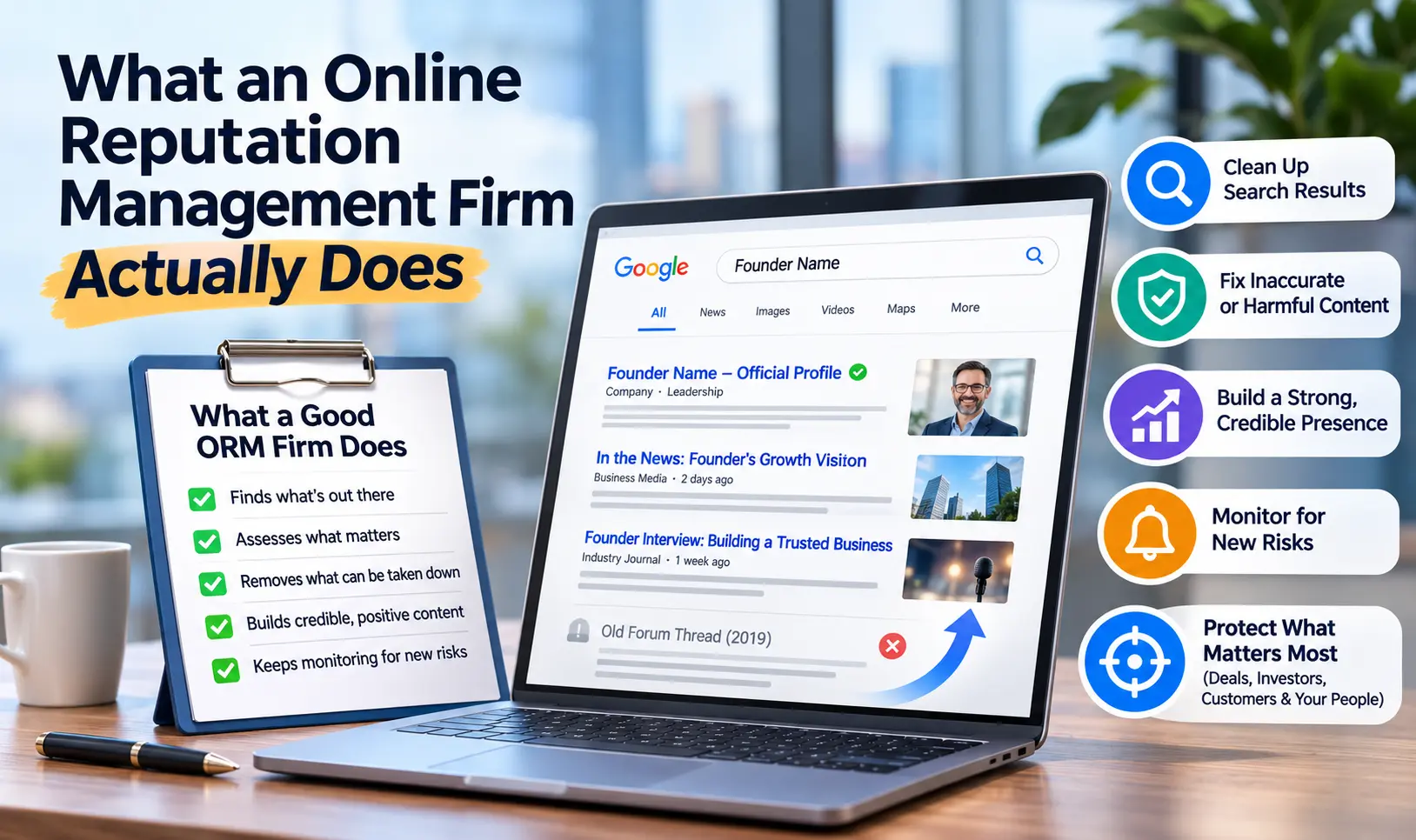
- Find out what’s actually out there. Not just Google page one. We look at search results in several countries and languages, news archives, review platforms, employer sites like Glassdoor, court and regulatory databases, social media, and what AI assistants say when asked about you. A typical engagement covers more than 200 sources. Clients are often surprised by what turns up, and occasionally relieved by how little.
- Decide what matters. A single bad restaurant review is noise. A misleading article ranking third for your CEO’s name, during a fundraise, is a real problem. We sort findings by who is likely to see them and what decision they might influence.
- Separate what can be removed from what has to be outranked. Some content breaks platform rules or local law: impersonation, leaked personal data, fake reviews, defamation that a court has already ruled on. That can often be taken down through proper channels. Accurate but unflattering reporting can’t, and shouldn’t be. That content gets put in context and pushed down by publishing better, more relevant material.
- Build the replacement. This is the slow part. Executive profiles, thought-leadership pieces, properly maintained company pages, interviews, and owned content that deserves to rank. It has to be real and useful, because search engines have become very good at spotting filler.
- Keep watching. Reputation isn’t a one-off repair. New content appears every day. Ongoing monitoring means a problem gets spotted in hours, not when a journalist calls.
When something is already on fire, the order changes. Our crisis containment work starts within 72 hours and focuses on stopping the story spreading before anything else.
Red flags: how to spot a bad ORM firm
This industry has some genuinely shady corners. We’d rather you hear it from us than learn it the hard way. Walk away if you see any of these.
“Guaranteed removal in 7 days.” Nobody controls Google, a newspaper’s editor or a court. A firm can promise effort, method and honest reporting. It can’t promise a specific outcome on a specific date for content it doesn’t own.
Fake reviews, sold as “review generation.” Buying or inventing reviews breaches the rules of Google and most review platforms, and consumer protection laws in many countries. When it’s caught, and it often is, the platform may flag or penalise your listing. You end up worse off than you started.
Fake legal notices. Some operators file fraudulent copyright or court-order takedown requests to get content removed. This has been documented and reported on repeatedly. It can work briefly. Then the request gets exposed, and the story becomes “company tried to censor critics.” That story ranks very well.
No questions about whether the content is true. A good firm will ask you, sometimes uncomfortably, what actually happened. If the criticism is fair, the right answer might be fixing the underlying issue first. A firm that never asks is a firm that doesn’t care what it’s covering up.
Vague reporting. “We’ve improved your sentiment” means nothing. You should get specific search positions, specific URLs, and a clear record of what was done.
Pressure to sign today. Real crises are urgent, yes. But a reputable firm can explain its plan clearly in a single call. If you’re being rushed past the details, there’s usually a reason.
Seven questions to ask before you hire an online reputation management firm
You don’t need to be an expert to vet a firm. You just need to ask a few direct questions and listen closely to how they’re answered.
- What will you do in the first 30 days? Look for specifics: an audit, a written priority list, named platforms. “We’ll start building positive content” before anyone has looked at your situation is a warning sign.
- What can’t you fix? Honest firms answer this one easily. Evasive ones change the subject.
- How do you handle content that’s accurate but unflattering? You want to hear about context, response and outranking. Not deletion.
- Who will actually do the work? Some firms sell with senior people and deliver with juniors or offshore subcontractors you never meet. Ask.
- How do you report progress? Ask to see a sample report, with client details removed. Is it specific? Could you take it to your board?
- How do you protect confidentiality? If a firm drops other clients’ names to impress you, assume it will drop yours too.
- Do you work with our lawyers? For anything involving litigation, regulators or a pending deal, your reputation firm and legal counsel need to talk. A firm that wants to work around your lawyers is a liability.
Why location still matters, especially in Dubai and the Gulf
The internet is global, but reputation problems rarely are. Laws, languages and platforms differ from one market to the next, and a firm that only knows one of them will miss things.
Take the UAE. Many of our clients are headquartered in Dubai but raise money in London, hire in India and sell across the GCC. Their reputation lives in at least three search markets and two or three languages. An Arabic-language article that never shows up on google.com can still rank first on google.ae. A Hindi news piece can sit quietly for years until an Indian partner’s compliance team finds it.
The legal toolkit varies too. The UAE treats online defamation and false information seriously under its cybercrime law, Federal Decree-Law No. 34 of 2021. That opens routes that simply don’t exist in some other countries. On the other hand, Europe’s “right to be forgotten” delisting requests are available for EU and UK searches, not for results shown in the Gulf. A good firm knows which door to knock on, in which country, and when to bring in local counsel rather than guess.
This is why we built our multi-region reputation defence practice around 14 jurisdictions rather than a single search engine.
The best time to call is before you need to
Back to that founder from the start. The forum thread was fixable. The supplier’s withdrawal letter existed, there were credible people willing to go on record, and there was a decent story to tell about the business. Given two or three months, it would have been a non-issue. Given three weeks and an investor already looking, it cost real money.
That’s the pattern almost every time. Reputation work is cheaper, calmer and far more effective when it’s done before a fundraise, an acquisition, a leadership change or a public listing, rather than during one.
If you’re weighing up whether you need an online reputation management firm at all, start small. Find out what’s actually out there. BigBuzz offers a confidential digital risk assessment, reviewed by a senior practitioner rather than a sales team. Sometimes the honest answer is that you’re in good shape. We’ll tell you that too.
Frequently asked questions
How long does online reputation management take?
Removals that go through a platform’s own process can take days or weeks. Pushing down a well-ranked negative article usually takes three to six months, sometimes longer for very authoritative sites. Be wary of anyone who quotes a fixed timeline before they’ve done an audit.
Can an online reputation management firm delete negative articles?
Only in limited cases: when content breaks a platform’s policies, infringes copyright, exposes private data, or has been ruled defamatory by a court. Accurate reporting on a legitimate news site generally can’t be removed. It can be answered, put into context and outranked.
Is reputation management only for companies in trouble?
No. Many of our clients come to us with nothing wrong at all. They’re preparing for an IPO, a funding round or a senior hire and want to know how they look to a stranger before that stranger is an investor.
What’s the difference between an ORM firm and a PR agency?
A PR agency mostly manages relationships with the media and shapes news coverage. An ORM firm manages what people find when they search, read reviews or ask an AI tool about you, long after the news coverage is over. The two often work well together.
How much does an online reputation management firm cost?
It depends heavily on scope. Monitoring one executive’s profile is a very different job from defending a multinational in several languages during a crisis. A credible firm will scope the work after an assessment, not quote a number on the first call.
Pingback: How to Choose an Online Reputation Management Firm | BigBuzz - Online Digital Reputation Management Company in Dubai