
 Home
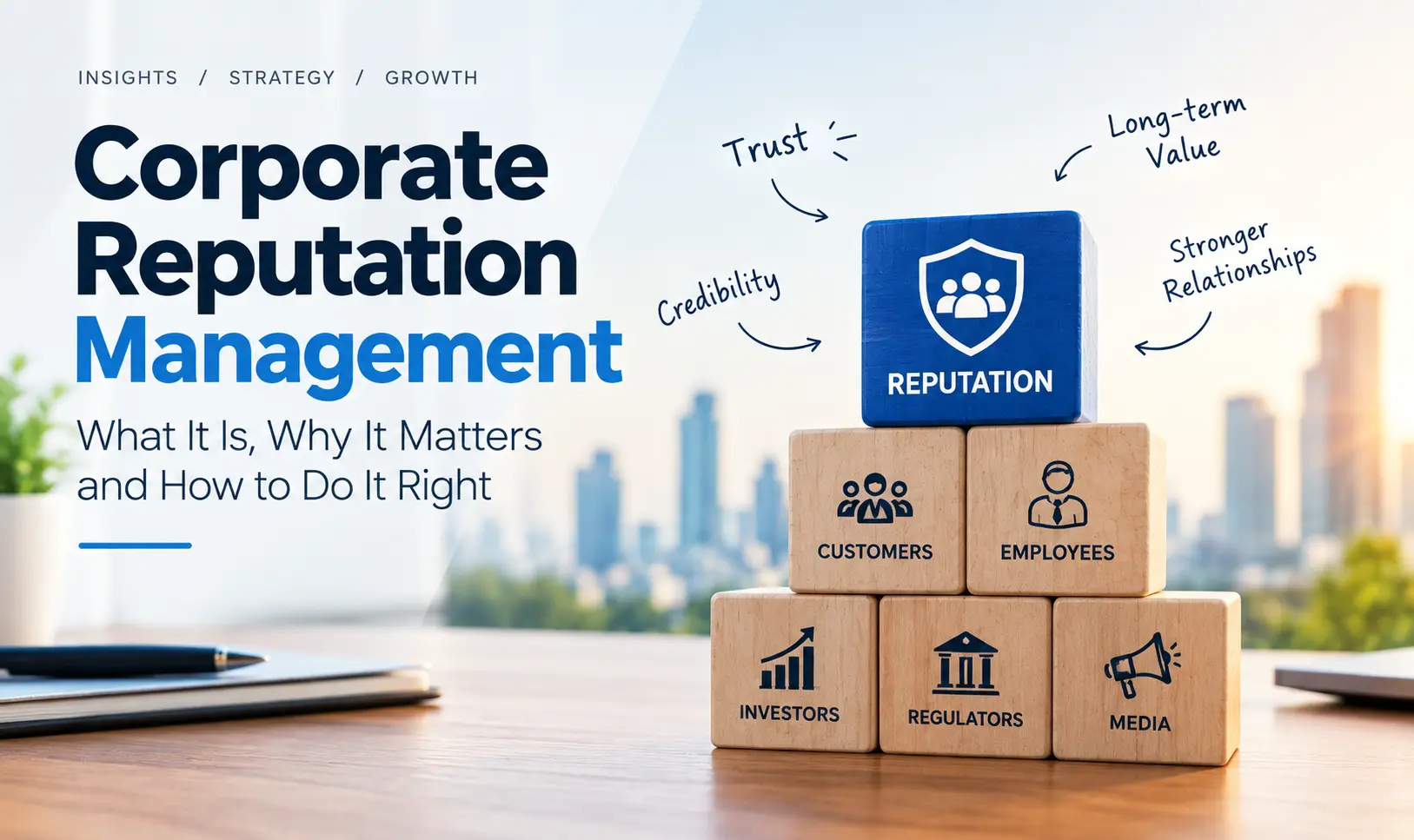
Corporate Reputation Management: What It Is, Why It Matters and How to Do It Right
A company can spend twenty years building trust and lose most of it over a weekend. One angry customer video. One leaked internal email. One CEO interview that goes sideways. By Monday morning, the share price has dipped, the sales team is fielding awkward calls, and the HR inbox is full of candidates quietly withdrawing their applications.
That is why corporate reputation management has moved out of the PR department’s back office and into the boardroom. It is no longer about sending press releases and hoping journalists are kind. It is about how a business behaves, how it talks, and how it responds when things go wrong.
In this guide, we’ll break down what corporate reputation management actually means, why it matters more today than it did even five years ago, and the practical steps companies of any size can take to protect and grow their good name.
What Is Corporate Reputation Management?
Corporate reputation management is the ongoing process of shaping, monitoring and protecting how a company is perceived by the people who matter to it: customers, employees, investors, regulators, the media and the wider public. It combines communication, customer experience, corporate behaviour and crisis planning into one continuous effort.
Here is the simplest way I explain it to clients. Your brand is what you say about yourself. Your reputation is what everyone else says about you when you’re not in the room. Corporate reputation management is the work of closing the gap between those two.
A few points worth underlining:
- It is ongoing. Reputation is not a campaign with a start and end date. It is built (or eroded) every single day.
- It covers every stakeholder. A company can be loved by customers and still distrusted by employees or investors. Real reputation management looks at all of them.
- It is mostly about actions. Communication helps, but no amount of clever messaging fixes a bad product, poor service or unethical behaviour.
- It lives online and offline. Google results, review sites, social media, news coverage, Glassdoor ratings and word of mouth all feed into the same picture.
Reputation Management vs Branding vs PR
These three terms get used interchangeably in meetings, and that causes real confusion about who owns what. They overlap, but they aren’t the same thing.
| Branding | Public Relations | Corporate Reputation Management | |
|---|---|---|---|
| Main question | Who do we want to be? | What story are we telling right now? | What do people actually believe about us, and why? |
| Focus | Identity, visuals, tone, positioning | Media coverage, announcements, events | Trust and credibility across all stakeholders |
| Time frame | Long term, fairly stable | Short to medium term, campaign based | Continuous |
| Who controls it | Mostly the company | Partly the company | Mostly the audience |
| Typical owner | Marketing | Communications / PR | Leadership, with comms, HR, legal and customer teams |
The last two rows matter most. You control your brand. You only influence your reputation. That is exactly why reputation needs its own strategy instead of being treated as a side effect of good marketing.
Why Corporate Reputation Management Matters
It’s tempting to file reputation under “soft” business issues. That would be a mistake. A strong reputation shows up in hard numbers, and a damaged one shows up even faster.
1. Customers check before they buy
Most buyers now read reviews, scan Google results and ask around before they spend money, even on B2B services. If the first page of search results for your company shows complaints, lawsuits or a viral controversy, you’ve lost the sale before your sales team ever gets a chance.
2. Talent follows reputation
Good people have choices. Before accepting an offer, candidates look at employee reviews, LinkedIn posts from current staff and how the company treats people publicly. A poor employer reputation means higher hiring costs, longer vacancies and weaker applicants.
3. Investors price in trust
Investors and lenders look beyond the balance sheet. Governance problems, ethical controversies or a pattern of public mistakes are read as risk, and risk gets priced in. A trusted company tends to get the benefit of the doubt when it misses a quarter. A distrusted one rarely does. This is especially true during a deal or funding round, which is why many firms invest in IPO and fundraising reputation readiness well before investors start their due diligence.
4. It buys you goodwill in a crisis
Every company makes mistakes eventually. When a business with a solid track record slips up, people are more willing to accept an apology and move on. When a business with a shaky reputation slips up, the mistake confirms what people already suspected.
5. It makes everything else cheaper
A respected company spends less to win customers, less to hire, and less to calm regulators or partners. Reputation quietly lowers the cost of almost every business activity.
The Key Components of Corporate Reputation Management
In my experience, companies that manage reputation well don’t treat it as one task. They treat it as several connected areas, each with an owner.
Online presence and search results. For most people, your reputation is page one of Google. That includes your website, news articles, review platforms, Wikipedia (if you have a page), social profiles and forum threads. You can’t delete what others publish, but you can make sure accurate, helpful content about you ranks well. That is the idea behind search exposure engineering.
Customer reviews and feedback. Reviews on Google, Trustpilot, G2, app stores or industry sites carry huge weight. What matters isn’t only the star rating but how you respond, especially to the negative ones.
Media relations. Journalists still shape opinion, particularly for larger companies. Being open, accessible and honest with the press during good times makes it much easier to get a fair hearing during bad ones.
Employee experience and advocacy. Your staff are your most believable spokespeople, and your most damaging critics if they’re unhappy. Internal culture leaks out through reviews, social posts and conversations with friends. Employer review sites deserve particular attention; see our approach to Glassdoor and employee narrative risk.
Leadership visibility. People trust people more than logos. A CEO or founder who speaks clearly and consistently, and admits mistakes, does more for reputation than any brand campaign. The flip side is that a leader’s personal online profile becomes a company risk too, which is where founder and executive digital protection comes in.
Corporate responsibility and ethics. How you treat suppliers, the environment, communities and data increasingly decides how you’re judged. Claims here have to be backed by real action, or they backfire.
Crisis preparedness. The plan you write on a calm Tuesday decides how well you handle a chaotic Friday night. More on this below.
How to Build a Corporate Reputation Management Strategy
There’s no single template that fits every company, but the businesses that get this right tend to follow a similar path.
Step 1: Find out where you actually stand
Start with an honest audit. Google your company name, your products and your leadership team, and look at the first two pages. Read your reviews, all of them, not just the recent ones. Check what employees say on Glassdoor or LinkedIn. If budget allows, run a short survey with customers and staff. For larger organisations, a formal enterprise digital risk assessment maps this exposure systematically.
The goal isn’t to feel good. It’s to find the gaps between how you see yourself and how others see you.
Step 2: Identify the stakeholders who matter most
A consumer app, a B2B software firm and a manufacturing company will have very different priorities. List your key audiences, then note what each one cares about. Customers might care about price and reliability. Employees care about pay, growth and respect. Investors care about governance and steady performance.
Step 3: Decide what you want to be known for
Pick two or three qualities you want people to associate with your company, such as reliability, fairness or innovation. Then ask the harder question: what would we have to do for people to believe that? Reputation follows proof, not slogans.
Step 4: Set up monitoring
You can’t manage what you don’t see. Set up alerts for your company name, key products and executives across news, social media and review sites. Decide who checks them, how often, and who gets told when something unusual pops up. Ongoing reputation intelligence monitoring turns these alerts into trend reports leadership can actually act on.
Step 5: Create and promote content that tells the truth well
Publish useful, credible content: case studies, expert articles, customer stories, leadership commentary, transparent updates. This gives search engines and journalists accurate material to work with, and it pushes your real story higher in search results.
Step 6: Respond, don’t ignore
Reply to reviews, both good and bad. Thank people for praise. For complaints, acknowledge the problem, take the conversation private if needed, and follow up once it’s fixed. Prospective customers often read your responses more closely than the original complaint.
Step 7: Bring your employees with you
Keep staff informed, especially before big announcements or during a crisis. Nobody wants to learn about their own company’s problems from the news. Give willing employees easy ways to share company wins, but never force it. Forced advocacy is obvious, and it rarely works.
Step 8: Review and adjust regularly
Revisit your reputation audit every quarter or at least twice a year. Look at what’s improved, what hasn’t, and what new risks have appeared. Markets shift, and so do public expectations.
Handling a Reputation Crisis
Sooner or later, something will go wrong. A product fails, a data breach happens, an employee posts something offensive, or an old story resurfaces. How you respond in the first 24 to 48 hours often matters more than the original problem.
The textbook example is still Johnson & Johnson’s handling of the 1982 Tylenol poisonings. The company wasn’t at fault for the tampering, yet it pulled the product from shelves nationwide, put public safety ahead of short-term revenue, and later introduced tamper-proof packaging. Decades later, it’s taught in business schools as the right way to respond.
Compare that with companies that stayed silent, blamed customers, or issued a stiff legal statement while videos of the incident spread online. The pattern repeats: the cover-up or the cold response does more damage than the event itself.
A few principles hold up in almost every crisis:
- Respond quickly, even if you don’t have every answer. A short holding statement (“We’re aware, we’re looking into it, here’s when we’ll update you”) is far better than silence.
- Take responsibility where it’s yours. Hedged non-apologies are spotted instantly and shared widely.
- Show what you’re doing about it. People forgive mistakes more easily when they can see concrete action.
- Speak with one voice. Agree on a single spokesperson and a single set of facts so messages don’t contradict each other.
- Tell your own people first. Employees should hear it from leadership, not from a news alert.
- Follow up. Once things calm down, share what changed. This is how a crisis turns into proof of integrity.
The best time to prepare all of this is before you need it. A simple crisis playbook, covering who decides, who speaks and who approves statements, saves hours of panic when the pressure is on. If a situation is already unfolding, structured crisis containment and narrative stabilization can help steady things quickly. And where legal action is involved, every public word needs a litigation-sensitive reputation strategy.
Not sure how exposed your company is? BigBuzz.Online offers a confidential review of what investors, customers and talent see when they search for you. Request a confidential assessment.
How to Measure Corporate Reputation
Reputation feels intangible, but you can track it. Pick a handful of indicators and watch how they move over time rather than obsessing over any single number.
| What to track | What it tells you |
|---|---|
| Average review rating and review volume | How customers feel, and whether that’s changing |
| Share of positive vs negative results on page one of Google | What a first-time searcher sees about you |
| Sentiment of media and social mentions | The general tone of public conversation |
| Share of voice against competitors | How visible you are in your industry |
| Employee ratings and staff turnover | How your own people see you |
| Net Promoter Score (NPS) | Whether customers would recommend you |
| Response time to complaints | How seriously you take feedback |
Useful tools
You don’t need an enterprise budget to start. Google Alerts is free and covers the basics. As you grow, social listening and media monitoring platforms such as Brandwatch, Meltwater, Mention or Talkwalker can track mentions and sentiment at scale. Review management tools like Birdeye, Reputation.com or Trustpilot’s business tools help you collect and respond to reviews in one place. Google Business Profile and Google Search Console are also worth watching closely, since they shape what people see first.
Common Mistakes Companies Make
I’ve watched plenty of well-meaning companies hurt their own reputation. These are the mistakes that come up again and again.
- Treating it as a PR problem only. If the underlying product, service or culture is broken, communication just puts lipstick on it.
- Waiting for a crisis to care. Reputation built in quiet times is what protects you in loud ones.
- Arguing with reviewers in public. Even when the customer is wrong, a defensive reply makes you look worse to everyone else reading.
- Buying fake reviews or hiding bad ones. It’s unethical, it breaks most platforms’ rules, and it usually gets found out. When it does, the damage is far bigger than a few honest one-star reviews.
- Saying one thing and doing another. Sustainability claims without real action, “we value our people” followed by sudden layoffs over email: audiences notice the gap immediately.
- Ignoring employees. Internal frustration always finds its way outside eventually.
- Going silent when it gets uncomfortable. Silence lets other people write your story for you.
Frequently Asked Questions
What is corporate reputation management in simple words?
It’s the work a company does to understand, protect and improve how people see it. That includes customers, employees, investors and the public, both online and offline.
Is corporate reputation management the same as online reputation management?
Not quite. Online reputation management (ORM) focuses on search results, reviews and social media. Corporate reputation management is broader. It includes ORM but also covers leadership, culture, ethics, media relations and crisis response.
Who is responsible for corporate reputation in a company?
Ultimately, the leadership team. Day-to-day work is usually shared between communications or PR, marketing, HR, customer service and legal. Reputation suffers when everyone assumes it’s someone else’s job.
How long does it take to fix a damaged reputation?
It depends on how serious the damage is and how genuinely the company changes. Minor review or search issues can improve in a few months. Recovering from a major scandal can take years, and only happens if the behaviour behind it actually changes. Structured reputation recovery programs help by pairing real change with a plan to rebuild what people find online.
Can small businesses do corporate reputation management?
Absolutely. Small businesses arguably need it more, because a few bad reviews carry more weight when there are fewer reviews overall. Responding to feedback, keeping your Google Business Profile updated and treating staff well already cover a lot of ground.
Can negative content be removed from Google?
Sometimes. Content that is defamatory, breaks a platform’s policies or exposes private information can often be reported and removed. Honest negative reviews and accurate news stories generally stay. The realistic approach is to address the issue and publish strong, accurate content that gives people the fuller picture.
Final Thoughts
Corporate reputation management isn’t about controlling the conversation. You can’t, and trying usually backfires. It’s about earning trust through what you do, being honest about what you get wrong, and making sure the real story is easy to find.
Start small if you need to. Audit what people see when they search for you. Reply to your reviews. Talk to your employees. Write down what you’d do if something went wrong tomorrow. None of it is glamorous, but done consistently, it builds the kind of reputation that carries a business through good years and bad ones.
Want help putting this into practice? Explore our reputation management services, read more on our insights blog, or talk to our team confidentially.