
 Home
Search Engine Reputation Management: What Page One Says Before You Do
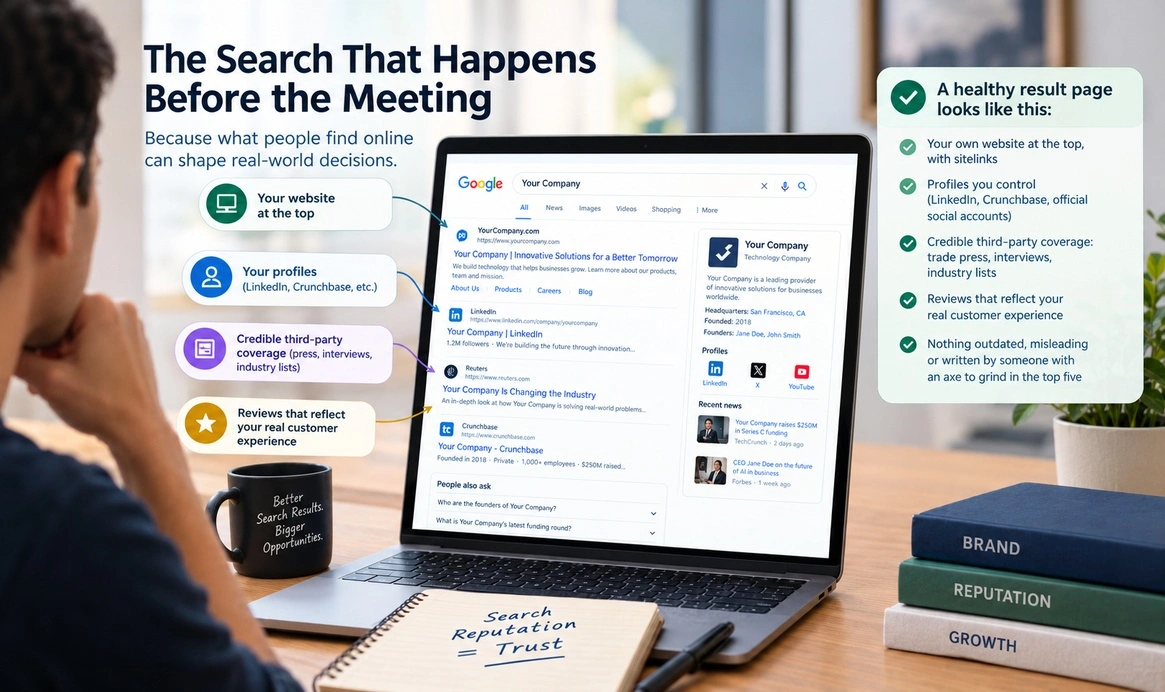
The search that happens before the meeting
Picture a founder four weeks out from closing a funding round. The term sheet is signed. The lawyers are on final drafts. Then one of the investors’ analysts does what analysts always do: types the founder’s name into Google.
Result number four is a 2019 blog post from a former business partner. It’s bitter, mostly inaccurate, and has been sitting there quietly for years. Nobody on the founder’s team has looked at page one in a long time. Why would they? Things are going well.
Maybe the round still closes. But now it takes three extra calls, an unplanned reference check, and a week of nobody sleeping. We see versions of this story more often than you’d think.
That’s what search engine reputation management is really about. Not vanity. Not “looking good online.” It’s making sure that when someone important searches for you, what they find is accurate, current and fair, because they will search, and they’ll usually do it before you’ve said a word.
What is search engine reputation management, really?
Search engine reputation management (often shortened to SERM) is the work of shaping what people see when they search for a company, a brand or a person. Mostly that means Google, but it also covers Bing, image and video results, autocomplete suggestions, and now the AI-written summaries that sit above the links.
The simplest way to think about it: your name is a keyword. Page one for that keyword has roughly ten organic spots, plus a knowledge panel, a “People also ask” box, maybe some news and a few images. SERM is the job of deciding what should fill those spots and then doing the slow, unglamorous work to get them there.
A healthy result page usually looks something like this:
- Your own website at the top, with sitelinks
- Profiles you control (LinkedIn, Crunchbase, official social accounts)
- Credible third-party coverage: trade press, interviews, industry lists
- Reviews that reflect your real customer experience
- Nothing outdated, misleading or written by someone with an axe to grind sitting in the top five
It sounds basic. For most organisations it isn’t, because page one is rarely something anyone actually owns.
SERM vs ORM: is there a difference?
People use the two terms interchangeably, and that’s mostly fine. But there is a useful distinction.
Online reputation management (ORM) is the broad discipline. It covers everything people say about you anywhere online: social media, review sites, forums, Glassdoor, WhatsApp groups you’ll never see.
Search engine reputation management is the narrower slice that deals with search results specifically. It asks one question: when someone searches for us, what do they find, and in what order?
Why does the distinction matter? Because a nasty thread on a niche forum with 40 readers is an ORM problem. The same thread ranking third for your CEO’s name is a SERM problem, and a much bigger one. Search is where scattered opinions get collected, ranked and handed to the people who matter most: investors, journalists, regulators, senior hires and acquirers.
In practice, good programmes do both. But if you only have budget or attention for one thing, page one is usually where we’d start.
Why page one carries so much weight
Here’s the uncomfortable part. Search engines rank what’s relevant and well-linked. They don’t rank what’s true. A five-year-old article about a lawsuit you won can outrank the press release announcing you won it, simply because more sites linked to the original story.
And the people searching aren’t casual. Think about who actually types your company name into Google with real intent:
- Investors and PE analysts running digital due diligence before a deal
- Acquirers checking whether a target carries hidden baggage
- Senior candidates deciding whether to take your offer
- Journalists looking for background before they call you
- Regulators and compliance teams at banks and partners
- Enterprise buyers shortlisting vendors
None of them will tell you what they found. They’ll just quietly ask harder questions, add a condition to the term sheet, or go with someone else.
There’s also autocomplete to think about. If someone types your brand name and Google suggests “lawsuit”, “scam” or “fraud” before they’ve finished typing, you’ve already lost a bit of trust, even if they never click.
How search engine reputation management works in practice
There’s no magic button, and anyone promising one should make you nervous. Real SERM work is closer to gardening than surgery. Here’s roughly how a proper programme runs.
- Map the search landscape first. We don’t start by building anything. We start by looking. Which searches matter? Your company name, yes, but also the CEO’s name, founders, the name plus “reviews”, “complaints”, “lawsuit” or “funding”. We check them across countries too, because page one in Dubai can look very different from page one in London or Mumbai.
- Sort every result into three buckets. Owned (your site, your profiles), earned (press, reviews, mentions) and problematic (outdated, inaccurate, hostile or simply irrelevant). Most companies are surprised by how little of page one they actually own.
- Fix the easy things. Outdated bios, broken profiles, old leadership pages, an About page that hasn’t been touched since 2021. It’s boring, but this alone can move results.
- Build assets that deserve to rank. Strong executive profiles, a newsroom, genuine thought-leadership pieces, interviews, conference talks, well-maintained profiles on high-authority platforms. The point isn’t to flood Google with fluff. It’s to give search engines better, more relevant answers than the problem content.
- Deal with the problem content directly where you legitimately can. Some content can be corrected, updated or removed (more on that below). Some can be answered: a calm, factual response often defuses a thread better than any suppression campaign.
- Monitor, because page one moves. A new news story, a viral Reddit post or a Google algorithm update can reshuffle everything in a week. This is where our Reputation Intelligence Monitoring work comes in.
At BigBuzz, the hands-on part of this sits within our Search Exposure Engineering practice. But the order matters more than the label: understand first, act second.
What can actually be removed (and what can’t)
This is the question we get asked most, so let’s be straight about it.
Things that often can be removed or de-indexed:
- Personal contact details like a home address, phone number or personal email. Google’s Results about you tool lets individuals find these in search and request removal directly.
- Doxxing content, leaked login credentials and certain sensitive financial or ID data, through Google’s legal and personal-information removal forms.
- Content that breaks the hosting platform’s own rules: fake reviews, impersonation, harassment.
- Material that’s clearly defamatory, where there’s a court order or a strong legal basis.
- Outdated pages the publisher agrees to update or take down. You’d be amazed how often a polite, well-reasoned email to an editor works.
Things that usually can’t be removed:
- Accurate news coverage you simply don’t like
- Honest negative reviews
- Court records and many public filings
- Opinion, even unfair opinion, as long as it stays within the law
One thing worth knowing: when Google removes a result, the page itself still exists on the original website. It just stops appearing in search. So removal and real resolution aren’t always the same thing.
For the content that stays, the honest route is suppression through relevance: building enough strong, accurate content that the problem result slides from position three to page two. Very few people click past page one, so in practice that’s often enough. It just takes months, not days.
If someone promises to “delete” a legitimate news article from the internet in a week, walk away. At best they’re overselling. At worst they’re using tactics that can backfire badly once a journalist notices.
AI search has changed what “page one” means
A couple of years ago, a searcher saw ten blue links and made up their own mind. Today, a lot of them read a short AI-generated summary first, either in Google’s AI answers or in a chatbot, and many never scroll further.
That summary is built from whatever the AI can find and trusts. If the most-cited sources about your company are an old controversy and a couple of angry forum threads, that’s what gets summarised. Calmly. Confidently. In a tone that sounds neutral, which somehow makes it worse.
So modern search engine reputation management has to think about two audiences: the human scanning results, and the machine deciding what goes into the answer box. The good news is that the same things help with both:
- Clear, factual information about your company on your own site, kept up to date
- Consistent details across profiles, directories and Wikipedia-style sources
- Credible third-party coverage that AI systems treat as reliable
- Getting ahead of Reddit and forum threads, which AI tools now quote heavily
It’s worth asking a few AI assistants about your company every quarter and reading what they say. It’s a quick, slightly uncomfortable exercise, and very revealing. We wrote more about this shift in Your Brand Is Being Judged Before You Speak.
Mistakes we see again and again
Waiting for a crisis. By far the most common one. Building authority in search takes months. If you start the week a damaging story breaks, you’re already behind. The best time to work on page one is when nothing is wrong.
Forgetting the people. Companies polish their brand results and ignore the executives. But investors search the founder and the CFO just as hard as the company. An empty or outdated executive profile leaves space for someone else to fill. Our Founder & Executive Digital Protection work exists largely because of this gap.
Arguing in public. Replying angrily to a negative review or a critical article usually just gives it more engagement, more links and a higher ranking. Respond once, calmly and factually, then move on.
Buying cheap fixes. Spammy backlinks, fake reviews and hundreds of thin “positive” articles. Search engines are good at spotting this, and when it’s exposed, the story stops being about the original complaint and becomes about the cover-up.
Only checking Google.com from your own office. Results vary by country, language and device. A board member in Riyadh, an investor in Singapore and a journalist in London may all see different page ones.
When it makes sense to bring in specialists
Plenty of this you can start yourself. Search your company and leadership names in a private browser window this afternoon. Write down every result on page one and be honest about which ones you’d be comfortable with an investor reading.
But it’s worth getting outside help when:
- You’re heading into a fundraise, IPO or acquisition and know digital due diligence is coming (see our IPO & Fundraising Reputation Readiness programme)
- There’s active litigation and anything you publish could matter legally
- A problem result has sat on page one for months despite your efforts
- You operate across several countries and page one looks different in each
- Your leadership team has a public profile that’s grown faster than anyone has managed it
At BigBuzz, we work with public companies, PE-backed businesses and leadership teams across the Gulf and beyond. Every engagement starts the same way: a confidential look at what your stakeholders actually see when they search, before we recommend anything.
If you’d like to know what your page one is saying about you, request a confidential assessment. It’s a short conversation, and you’ll come away knowing exactly where you stand.
Frequently asked questions
How long does search engine reputation management take?
Small fixes, like updated profiles or a corrected article, can show up within a few weeks. Pushing a well-established negative result off page one usually takes three to nine months, depending on how authoritative that page is and how competitive your name is in search.
Can you remove a negative Google result completely?
Sometimes. If the content breaks Google’s policies, breaks the host platform’s rules or is clearly unlawful, removal is often possible. Accurate news and honest reviews generally can’t be removed, so the realistic goal there is to make sure better, more relevant content ranks above them.
Is SERM only for companies in trouble?
No. Most of our best work happens when nothing is wrong yet. Building a strong page one in advance is far cheaper and more effective than trying to build one in the middle of a crisis.
Does SERM cover executives as well as the company?
It should. For many stakeholders, especially investors, the founder’s or CEO’s name is searched as often as the company name, and sometimes more.
Is search engine reputation management the same as SEO?
They share techniques, but the goals differ. SEO tries to win traffic for keywords customers search. SERM focuses on the searches about you, and on accuracy and trust rather than clicks.