


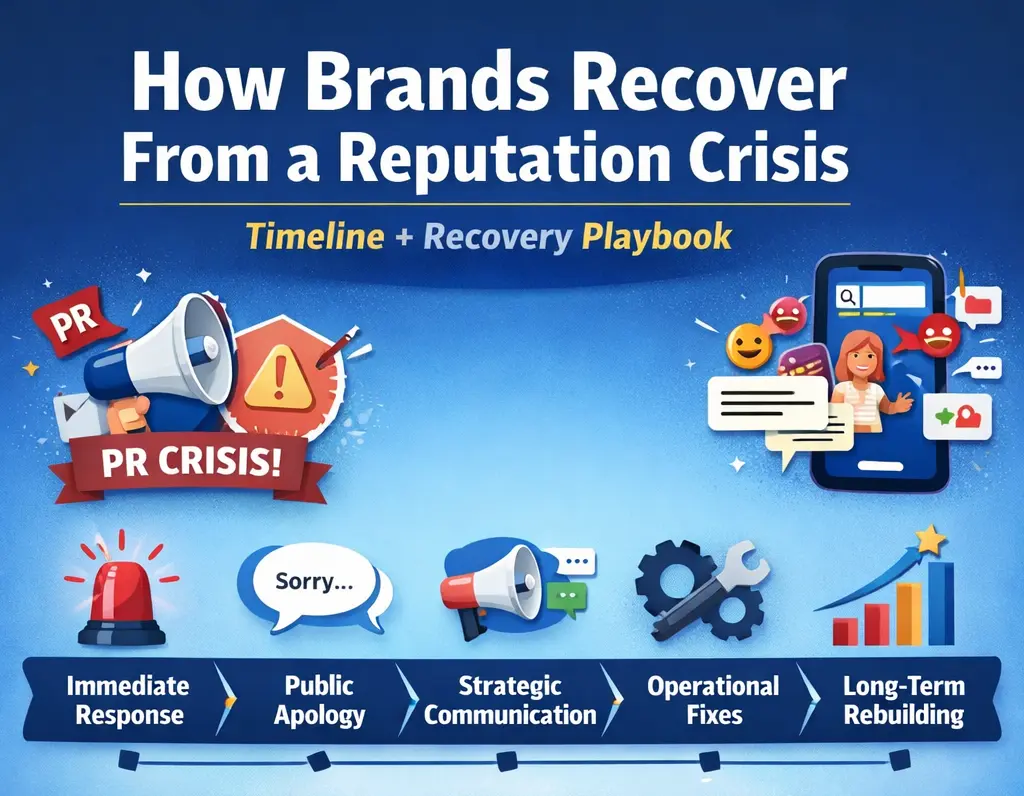
How Brands Recover from a Brand Reputation Crisis lets understand this from examples and before that get an understanding as to what can possibly happen if brand Reputation crisis is not managed. A brand is built over years of hardwork and trust. But a small mistake or lethargy or negativity can wipe out years of trust and revenue (In Millions).
Let us look at few examples to understand it better.
Example 1: United Airlines
Its 2017, and a video goes Viral making United Airlines lose 1 Billion USD in its market cap no small cost for any business of any measure. The Reason, A Violent passenger removal incident that spread across social media faster than the airline’s crisis team could react.
This isn’t an isolated event. According to the World Economic Forum, reputation risk now accounts for over 25% of a company’s market value. In the age of social media, Reddit threads, review platforms, and AI-driven search summaries, a reputation crisis is no longer just a PR issue—it’s a business survival issue.
A brand reputation crisis can erupt from a product failure, leadership scandal, customer mistreatment, or even a poorly worded tweet. What determines survival is not whether a crisis occurs—but how fast, how transparently, and how strategically a brand responds.
What we are going to decipher in this article is to break down following aspects:
1) What causes Reputation Crisis?
2) The real timeline brand follows during recovery
3) A step-by-step crisis recovery playbook (Based on case studies)
Reputation crisis can happen in a jerk or build over time silently creeping like a deadly snake and one day bites you to death. Following here are causes
In 2017, United Airlines forcibly removed a paying passenger from an overbooked flight. What followed was a severe backlash after the video went viral, making people believe that injustice was done. Within 48 hours:
Outcome:
United later issued a public apology, revised overbooking policies, and committed to internal reforms—but reputational damage was done and it lingered for years.
Products failing which create safety issues or hampers or leads to an untoward incident happens can be critical for reputation.
Example:
In 2016, Samsung recalled the Galaxy Note 7 after reports of battery explosions.
Immediate impact:
Outcome:
Samsung rebuilt trust through transparency, engineering reform, and a redesigned quality assurance process. Samsung was able to do it through rigor and right steps but not everyone has right advice and strategy in time.
Leadership behavior directly reflects brand values. When personal brand becomes conjoint with Business brand it demands greater scrutiny of your actions as an individual or founder.
Example:
In 2018, Facebook (now Meta) faced backlash over the Cambridge Analytica data scandal.
Outcome:
User trust declined, regulatory scrutiny increased, and the brand had to invest heavily in compliance, transparency reporting, and public communication. Mark Zuckerberg did admit and issued an apology however, his personal and brand image did take a hit.
Influencers and communities can amplify narratives overnight. There exists a group/community and influencers who have large dedicated followers and when they post something where there followers feel emotionally obligated to share can turn a nightmare for any brand.
Example:
Pepsi pulled its 2017 Kendall Jenner ad within 24 hours after accusations of trivializing social justice movements.
Outcome:
Fast withdrawal helped contain damage, but the incident remains a reputational reference point. Pepsi was quick to act having crisis management and social monitoring in place.
Every major crisis follows a predictable recovery timeline. Brands that understand this timeline recover faster—and cheaper. The ones who do not have it learn hardway.
Goal: Contain misinformation and stop narrative free-fall.
What works:
What fails:
Example:
United Airlines’ delayed empathy response worsened public anger in the first 48 hours
Goal: Restore emotional trust before operational trust.
Effective apologies:
Example:
Starbucks closed 8,000 stores in 2018 for racial bias training after a customer discrimination incident—turning apology into action.
Goal: Control narrative across channels.
Actions include:
Example:
Samsung published detailed technical explanations and progress updates during the Note 7 crisis, signaling transparency.
Goal: Prove change is real.
This includes:
Example:
Samsung introduced an 8-point battery safety check and publicized it globally.
Goal: Replace crisis memory with trust signals.
Tactics:
Example:
Tylenol rebuilt trust after the 1982 poisoning crisis through tamper-proof packaging—setting an industry standard.
Set up a real time social listening and reputation monitoring, track mentions, sentiment, keywords, hashtags, across platforms, discussion forums such as Reddit and Quora. This can be done using multiple tools available in the market such as Brandwatch, Brand24, Sprinklr, Mentions, Talwalker, Locobuzz, Konnectinsights etc.
Before responding, brands must answer:
This prevents reactive, inconsistent messaging.
Create a single source of truth:
Different stakeholders need different messages:
Post-crisis, brands must out-publish negativity with:
Mini Case Study 1: Tylenol (1982)
When cyanide-laced capsules killed seven people, Johnson & Johnson pulled 31 million bottles from shelves nationwide—before regulators demanded it. The company accepted millions in immediate losses, redesigned packaging with tamper-evident seals that became an industry standard, and communicated every move publicly. They chose transparency and safety over damage control.
Result: Within a year, Tylenol reclaimed market leadership. The response didn’t just save a product—it established the template every crisis team still studies (Harvard Business Review).
Key moves:
Mini Case Study 2: Samsung Galaxy Note 7 (2016)
After reports of exploding batteries, Samsung didn’t issue a quiet recall—they killed the entire product line, grounded the phone on airlines, and published detailed engineering failure reports. They overhauled quality assurance protocols, submitted to third-party audits, and didn’t launch a replacement until they could prove it was safe. The financial hit was massive.
Result: Within two product cycles, Samsung regained global smartphone leadership because they demonstrated they valued customer safety over quarterly earnings (Counterpoint Research).
Key moves:
“Reputation recovery is not PR—it’s operational, emotional, and digital.“
Brand Reputation Crisis can happen to best of brands, what matters is how you respond to it. At BigBuzz we not only help brand manage reputation crisis, but we believe in preventing it all together.

 Home
Home